
Consequences of Earthly Wisdom

God will not share sacred space with those whose wisdom becomes corrupted by false teachers and earthly wisdom. When mortals seize equality to God by deciding for themselves what is right and wrong (Genesis 3:5), they make themselves a “satan” to be driven out of God’s presence (Genesis 3:23–24) and paid out in thorns (Gen 3:17-19).
Satan (sa₂-ta-An) means “(one who) seizes equality with the God of heaven”:
That is why mortals (adam; ad₃,₆,₇-am₃) who seize equality with God by following their own earthly wisdom instead of God’s heavenly wisdom are “driven away” (adam; ad₂-am₃) and “paid out in thorns” (adam; ad₅-am₂):
ad₃,₆,₇-am₃ = “to be mortal (a corpse)”
ad₂-am₃ = “to be driven away”
ad₅-am₂ = “to be paid out in thorns”

The Mortal
Mortals who forsake the “water of life” live lives of fear and anxiety in an existence that is barren of God’s wisdom.
Yet God’s response to sinners combines both grace and justice. As Old Testament scholar Bill Arnold observes, divine punishment in the Hebrew Scriptures follows a pattern of poetic justice [Genesis 2009, page 68]:
“In the Hebrew Scriptures, divine punishment mirrors precisely the sin being punished. Judgment and punishment follow a sort of ‘poetic justice,’ meaning the penalty inflicted on the sinner matches repayment in kind for the harm done in the offense.”
This can be seen in the consequences decreed by God for the mortal, the serpent, and the mortal’s wisdom-wife. God tells the mortal:
“Because you listened to the voice of your wife, and have eaten from the tree about which I commanded you, saying, ‘You shall not eat from it’:
Cursed (arura) is the ground (adamah) because of you.
Through painful toil you will eat food from it all the days of your life.
It will produce thorns and thistles for you [ad₅-am₂],
and you will eat the plants of the field,
by the sweat of your brow you will eat your food,
until you return to the ground (adamah) since from it you were taken;
for dust you are and to dust you will return [saḥar(-da)...gi₄].” (Genesis 3:17–19)
God had honored the mortal with the priestly role of sharing the water of God’s wisdom and protecting the sacred space of Eden. This was the “water of life” the mortal was to share with others as a part of their priestly duties (abadah, Genesis 2:15):
a₂-ba-da₁,₁₃-a = “to be entrusted with the work of letting out the water”
a₂ = arm; strength; power; work
ba = to open
da₁₃ = (v.) to leave with a person, entrust; abandon [taka₄, da₁₃, page 273]
a = water
a₂-bad₃-a = “to protect enclosed (sacred) space with water”
Yet the literal description in Sumerian for what the mortal was doing — a-ru-a, “to pour out water” — was an idiom that referred to a votive offering, a response of gratitude to God:
a-ru-a = “power to pour out water”
a-ru-a = votive offering; to dedicate; to give a votive gift [a…ru, page 73]
But the mortal who abandons the water of life and grasps for equality with God abandons gratitude in favor of self-sufficiency.
Therefore God’s divine justice declares that the ground that once blessed the mortal with provision will now be cursed (arura). The simple replacement of a single morpheme [a-ru-a —> a-ru-ra] depicts how the mortal’s existence, once simple and abundant when watered with God’s wisdom, will become difficult and toilsome.
The faithless mortal who abandons the water of life will only be able to “send water” (a-ru) and obtain their food by “striking” (-ra) the ground:
a-ru-a = “power to pour out water”
a-ru-ra = "to strike (the ground) to send water”
The consequences of rejecting God’s wisdom are also conveyed when God tells the mortal, “By the sweat of your brow you will eat your food”.
Assyriologist and biblical scholar Daniel Fleming explains in “By the Sweat of Your Brow: Adam, Anat, Athirat, and Ashurbanipal” that in the Ancient Near Eastern context, the reference to “sweat” indicates more than simple physical exertion or hard labor. It actually signifies the fear, vulnerability, and helplessness that the mortal will experience when they try to be their own “god” — a suitable penalty for forsaking the generous provision, protection, and wisdom of God.
God’s poetic justice is also seen when God reminds the mortal that without following the heavenly wisdom that leads to Life, they are a corpse (adam) that will eventually return to the ground (adamah) in Death — eternal separation from God.
There is wordplay here where adam sounds like adamah in Hebrew, suggesting an association between the “adam” and the ground from which it came. In Sumerian, this association becomes clearer:
ad₃,₆,₇-am₃ = “to be a corpse (mortal)”
ad₃,₆,₇-am₃-a₂-a = “time turns a corpse into…” (the ground; dust; soil; earth)
This is because a decaying body returns to the dust of the ground. There is irony here: those who are willing to abandon God’s care as long as it does not cause their biological death must now stay alive by cultivating the very ground that will eventually become their grave. It becomes a constant reminder of their own mortality — the meaning of the Sumerian idiom, saḥar(-da)...gi₄ — “to return to dust.”
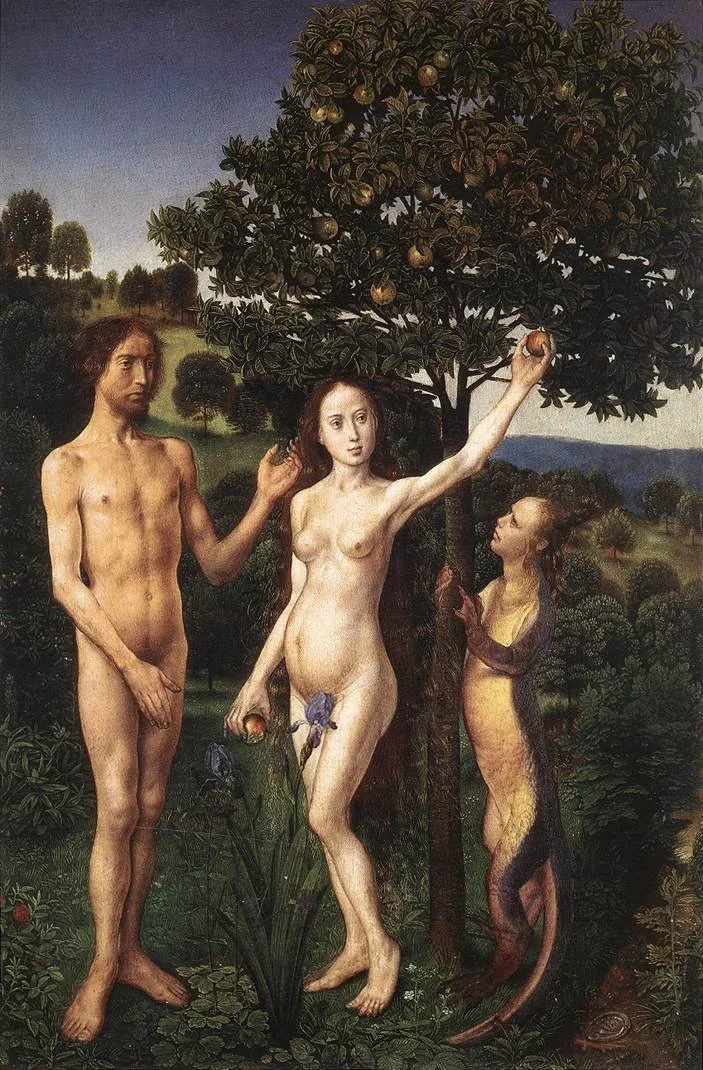
[Image: “The Fall”, Hugo van der Goes (c. 1467-1468)]
The Serpent
God also metes out poetic justice to the deceiver:
“Because you have done this,
“Cursed (arur) are you above all livestock and all wild animals!
You will crawl on your belly
and you will eat dust
all the days of your life.
And I will put enmity
between you and the woman,
and between your offspring and hers;
he will strike your head,
and you will strike his heel.” (Genesis 3:14-15)
God declares the “crafty” (arum) serpent will be “cursed” (arur). The Sumerian wordplay shows God repaying the ambitious and malicious serpent according to its own schemes. This false teacher had thought itself equal to God the Father and able to usurp his authority (arum):
a-ru₃-um = "wise" old woman (who claims) to be equal to the father
ru₃ = to equal in size or rank [rù, page 14]
a-ru-um = “old woman who replaces the father”
In response to the serpent’s attempt to remove God’s power in Eden, God used his power to remove the serpent’s legs (arur/a₂-ru-ur₂):
a₂-ru-ur₂ = “power to remove the legs”
The context of Genesis 3:14 suggests that the serpent of the story would have initially had legs like a lizard or a dragon (Revelation 20:2). But after God’s curse (arur), it will slither on the ground like a snake.
God also served fitting retribution for the serpent’s attack on God’s beloved mortal. The arum teacher sought to remove the “water of life” and thus destroy the mortal by leading it into the dust of Death with earthly wisdom:
a-ru-um = “skillful teacher who removes the water”
ar₂,₃-u₂,₃,₄,₈-um = “skillful teacher who disputes to destroy”
For this reason, God tells the serpent: “You will crawl on your belly and you will eat dust all the days of your life.”
To be clear, snakes do not eat dust — this is a theological metaphor. Dust is the “fruit” of death. Decayed corpses (adam) return to the dust of the ground (adamah). In the ancient Mesopotamian worldview, “dust” was not only associated with mortality, but more specifically with the underworld prepared for those who have abandoned relationship with God. Therefore, since words of Death came out of the serpent’s mouth, his punishment will be for the dust of death to enter the serpent's mouth and be its "food".
However, arur also has another meaning in Sumerian which is “strength to pay back the enemy” (a₂-ru-ur):
a₂-ru-ur = “strength to pay back the enemy”
This refers to the ongoing spiritual warfare that will continue between false teachers (the serpent’s offspring) and the offspring of the woman entrusted with the heavenly wisdom of God:
And I will put enmity
between you and the woman,
and between your offspring and hers;
he will strike your head,
and you will strike his heel.” (Genesis 3:15)
Wisdom’s children who follow God’s decrees will continually have to fight the false teaching of “serpents”. The serpent in Genesis 3 is the first depiction of a false teacher, but the people of God are warned to be wary of false teachers offering earthly wisdom throughout the Bible (Deuteronomy 18:20; Isaiah 9:15–16; Jeremiah 23:32; Micah 3:5; Matthew 7:15–16; Acts 20:29–30; 2 Timothy 4:3–4; 2 Peter 2:1–3).
While followers of God will face and attack false teaching directly — “striking its head” — the serpent’s approach comes from behind and is often undetected until the strike. Likewise, false teachers can often remain hidden among the people until the moment they lead them astray. This is depicted as an ongoing battle between God’s wisdom and false teaching until the time of Revelation when the great dragon at the end of the age is judged for deceiving the world with lies:
“The great dragon was hurled down — that ancient serpent called the devil, or Satan, who leads the whole world astray.” (Revelation 12:9a)
The Woman
Genesis 3 depicts the consequences given to those who forsake God’s wisdom, eat the forbidden fruit (apple/hashur), and lose the “water of life” as discussed in “Mortal Wisdom and the False Teacher”. This “fruit” leads the mortal into eternal debt-slavery to the Father of Lies:
hašhur = “apple”
hašhur = “everlasting debt-slavery”
God gives the woman — representing wisdom — to every mortal to help them share and protect the wisdom of God found in the “water of life” of Eden (Eden = “water of life”; Genesis 2:15, 18, 21-22):
e-dan₂,₃,₄,₆ = “pure, clear water”
e = water
dan₂,₃,₄,₆ = to be pure, clear
e-din = “water of life”
e = water
din = tin = (n.) life; (v.) to cure; to be healthy; to live [din, tin, pages 36 and 39]
If the mortal and its wisdom had been faithful, they would have continued to enjoy the protection and provision of God that leads to Life: right relationship with God in this life and the next.
But when the mortal’s wisdom-wife listens to the false teacher, she is led astray by earthly wisdom that claims it can replace God’s wisdom. And when the mortal’s wisdom is led astray, the mortal is led astray and eats the fruit because mortals always follow their own wisdom.
This explains the flow of the conversation when God confronts the mortal for eating the forbidden fruit (Genesis 3:11b-13):
“[And God said,] ‘Have you eaten from the tree that I commanded you not to eat from?’ The mortal said, ‘The woman you put here with me — she gave me some fruit from the tree, and I ate it.’ Then the Lord God said to the woman, ‘What is this you have done?’ The woman said, ‘The serpent deceived me, and I ate.’”
The mortal disobeyed God because his wisdom-wife gave him this “fruit” to eat. The mortal’s wisdom was deceived by the serpent and that is why she ate the “fruit” and offered it to her mortal.
This explains the poetic justice God serves to the disobedient wisdom of the mortal. He tells her:
“I will make your pains in childbearing very severe;
with painful labor you will give birth to children.
Your desire will be for your husband, and he will rule over you.” (Genesis 3:16)
Now just as the serpent’s penalty to “eat dust” was a theological metaphor, here the hardship of childbearing will be a metaphor for earthly wisdom’s “children”. It should be noted that God already instituted procreation and childbearing in Genesis 1:27-28a:
“So God created mankind in his own image,
in the image of God he created them;
male and female he created them.
God blessed them and said to them, “Be fruitful and increase in number; fill the earth and subdue it.”
But these women who are bearing children in Genesis 1 are already experiencing pain in childbirth because of human babies’ brain capacity.
Human babies are born with heads that are unusually large compared to the mother’s pelvis because the human species has bigger brains for higher intelligence, creating a tight fit that makes childbirth much more difficult and painful than in most other mammals. So pain in childbirth is not a new experience or a curse from God, but simply a fact of life based upon the biological constrains necessary for human existence. More importantly, Scripture consistently depicts children and childbearing as a blessing and a mark of divine favor, not a curse:
“[The Lord God] will love you and bless you and increase your numbers. He will bless the fruit of your womb….” (Deuteronomy 7:13a)
“Children are a heritage from the Lord, offspring a reward from him.” (Psalm 127:3)
“[The Lord God] settles the childless woman in her home as a happy mother of children. Praise the Lord.” (Deuteronomy 113:9)
Yet, Genesis 3:16 is going to make the difficulties of Lady Foolishness’s children analogous to painful childbirth. Just as the process of childbirth is painful, those mortals that are born of earthly wisdom will only obtain knowledge through pain and suffering. Because they have forsaken the wisdom of God which protects them from the anxiety, agony, and fear that comes with foolishness, they will struggle as they attempt to find Life in this world and the next.
Furthermore, God warns the wisdom-wife that her “desire will be for your husband — [the mortal] — and he will rule over you.” While this phrase does depict a role reversal, it too is a theological metaphor for the relationship between the mortal and its wisdom.
God gave the mortal the gift of wisdom so she could guide the mortal with God’s wisdom into eternal Life. This was the significance of the “rib” (Sumerian “ti”) from which she was created:
ti = “to take” [pages 1352-1354]
ti = “to become, to change into” [pages 1352-1354]
ti = til₃ = to live (of a single person); to keep alive, sustain [tìla, tìl, ti, page 33]
ti = til₃ = to be complete, completed; (to be) old, long-lasting; to make complete, finish
Mortal wisdom was supposed to love God’s wisdom, but now it loves its own wisdom instead. In other words, the wisdom-wife was supposed to rule and guide her mortal into Life that comes from imbibing the “water of life” from God. But now, the mind of mortality — Death — will rule the mortal’s wisdom and lead them both to the dust of the grave.
Previous: “Mortal Wisdom and the False Teacher”