
Genesis 1 — 11:
Historical Memory of Sumer-Akkad
How old is the Genesis account and which culture in history did it come from? How would an ancient Mesopotamian understanding of its message reshape our theology today?
While most evangelical scholars would agree that sound theological understanding flows downstream from biblical studies, the church has not yet realized that biblical studies in Genesis may be at least fifty years behind Mesopotamian research. This lag in scholarship began when postmodernism took over seminaries in the 20th century and shifted away from socio-historical interpretation to contemporary reader-centered interpretation. As a result, the church and its seminaries did not recognize the ancient cues in Genesis 1—11 that strongly suggest its historical events and worldview arose in ancient Sumer-Akkad of Mesopotamia.
Geographic, Geological, and Botanical Evidence
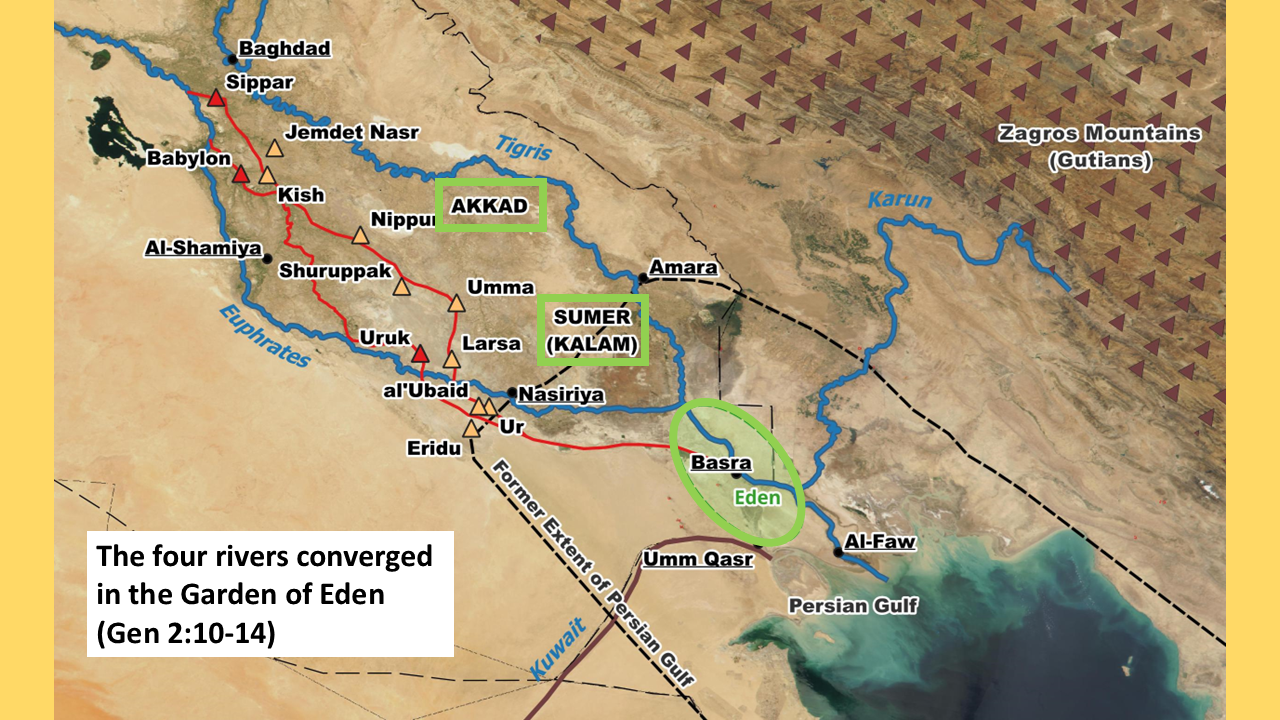
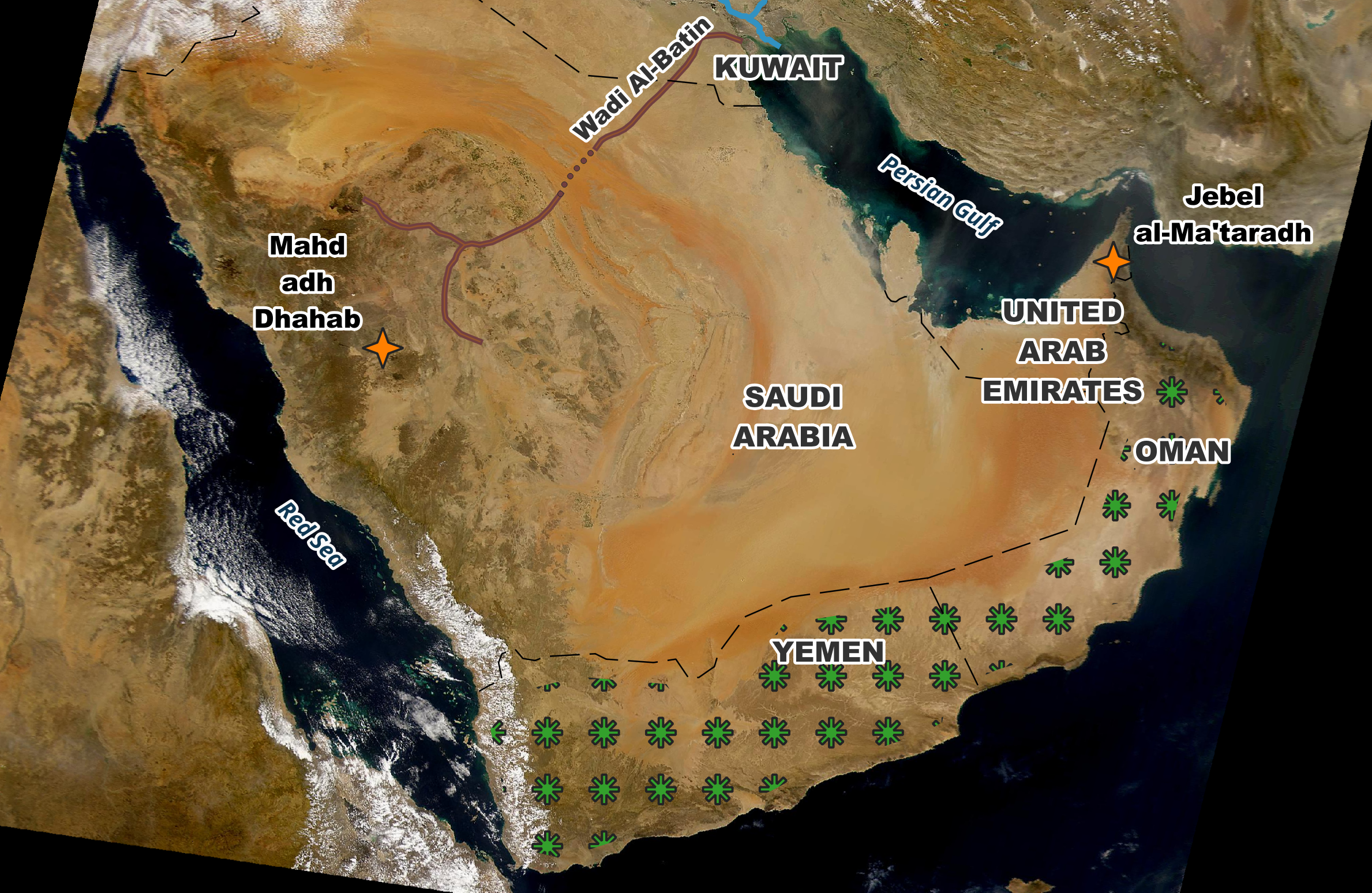
The first evidence of this is derived geographically, geologically, and botanically. Satellite imagery reveals the Wadi Al-Batin (“the hidden”), also known as the Kuwait River, is an ancient riverbed that flowed through the Arabian Peninsula and merged with the Tigris and Euphrates near the Persian Gulf (Map 1).
“A river flowed out of Eden to water the garden, and there it divided and became four rivers. The name of the first is the Pishon. It is the one that flowed around the whole land of Havilah, where there is gold. And the gold of that land is good; bdellium and onyx (šo-ham) stone are there. The name of the second river is the Gihon. It is the one that flowed around the whole land of Cush. And the name of the third river is the Tigris, which flows east of Assyria. And the fourth river is the Euphrates.” (Genesis 2:10-14)
In “The Garden of Eden: A Modern Landscape”, geologist Carol Hill explains that the Wadi Al-Batin is likely the ancient riverbed of the Pishon, which ran through a land rich with gold, bdellium, and the “shoham” stone. This stone is more probably carnelian but was mistranslated as onyx from onychion in the Greek Septuagint. Furthermore, the Hebrew word šo-ham sounds similar to šu₄-am₃ in Sumerian which means “to be red-brown” (šu₄ [red, brown] + am₃ [to be]), and would accurately describe the color of carnelian.
Carnelian was mined in Jebel al-Ma'taradh of the United Arab Emirates. Gold was abundant in the Mahd adh Dhahab (“cradle of gold”) of Saudi Arabia. Bdellium is produced by the Commiphora wightii/mukul and schimperi trees which grow in Oman and Yemen, respectively. This evidence strongly suggests the Arabian Peninsula is the land of Havilah (Gen 2:11) and the garden of Eden was located at the convergence of the Tigris (Hiddeqel), Euphrates (Perat), Karun (Gihon), and Kuwait (Pishon) rivers near modern-day Basra. This conclusion is further corroborated by the Dammam aquifer system which would have provided the water that flowed up from the ground in Eden (Genesis 2:6). When these geographical details are combined with the genealogical information in Genesis 5 and 11 and with Abram’s birth in 2166 BCE, they place Adam (c. 4000 BCE) and his descendants in the land of ancient Sumer-Akkad, also known as the Shinar plain (Genesis 10:8-10, 11:2).
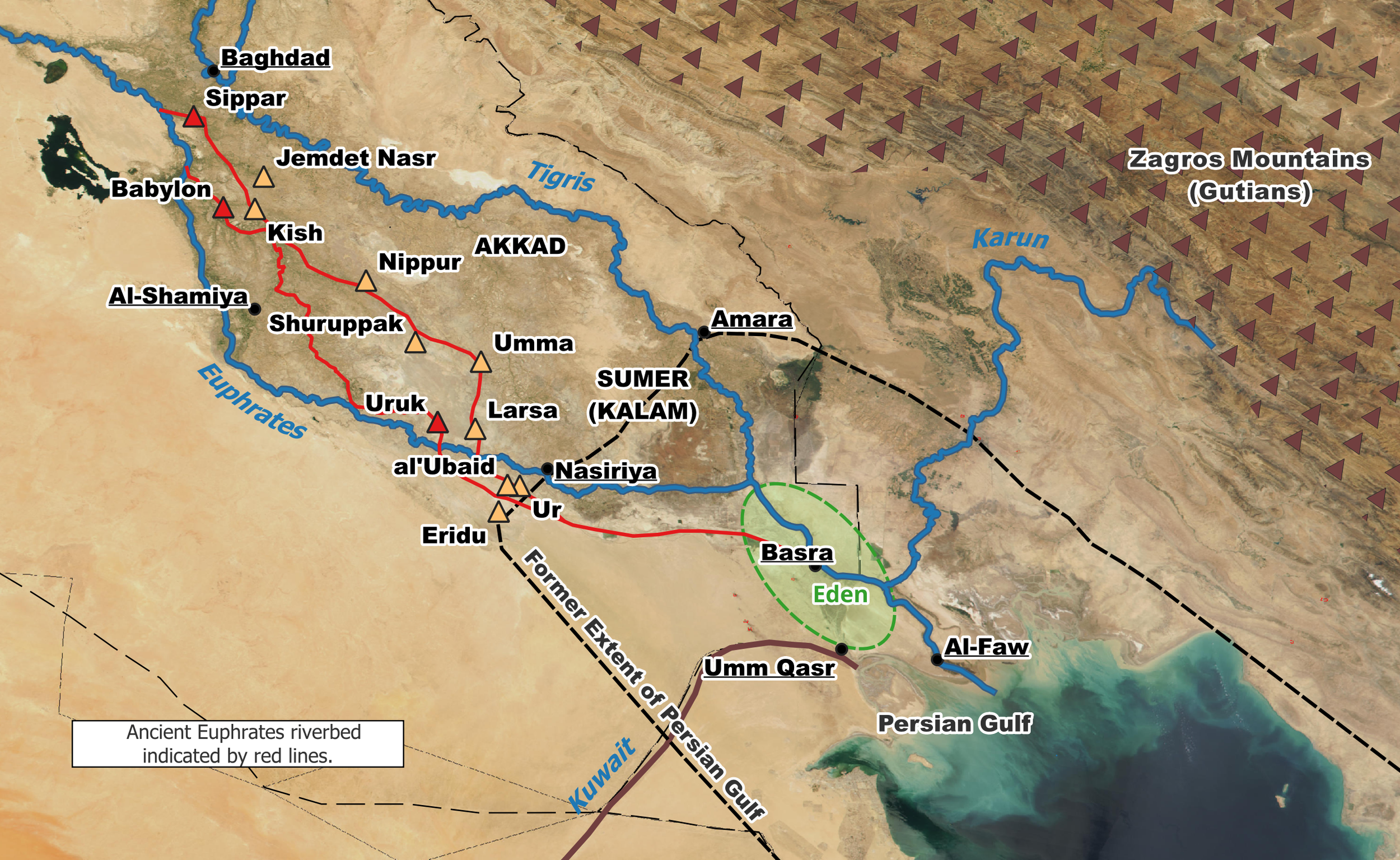
This is why all the locations of the events recorded in Genesis 2-11 can be found in the region of Sumer-Akkad (Map 2):
Eden was located at the convergence of the Tigris, Euphrates, Karun, and Kuwait rivers.
Eridu, the first city of Sumer, was built by Enoch for his son Irad (Gen 4:17-18).
The long-lived flood-hero came from Shuruppak (Gen 9:28-29; Sumerian Flood Story).
Babel/Babylon, Uruk, and Akkad (Gen 10:10; 11:2) were on the Shinar plain.
Nimrod/Sargon the Great of the Akkadians ruled the city of Kish (Gen 10:8-12).
Ur, one of the oldest cities of Sumer, was the home of Terah and Abram (Gen 11:28).
Linguistic Evidence
The second type of evidence comes from Sumerian and Akkadian words found in Genesis that can be studied with Halloran’s Sumerian Lexicon (book for scholars/abridged PDF for students), the Electronic Pennsylvania Sumerian Dictionary (ePSD), Cohen’s Annotated Sumerian Dictionary and the Electronic Babylonian Library (eBL).
It should be noted that Sumerian remained the lingua franca of scholarship in Mesopotamia until the 2nd century BCE. Sumerian is an agglutinative language with an oral tradition where each morpheme (syllable/polysyllable) is associated with a fundamental idea, nominal, or verb. Consequently, Sumerian words and names are translated as short sentences with a recognizable meaning. Likewise, many biblical words and names in Genesis are homophones and near-homophones with multiple meanings which enable wordplay (e.g. antanaclasis, paronomasia) as described in Scott B. Noegel’s book, “Wordplay” in Ancient Near Eastern Texts.
For example, the plain of Shinar (Genesis 10:9-10; 11:2) was the breadbasket of the ancient Tigris-Euphrates river valley. “Shinar” means “river(s) of life” and also sounds like the plain of “winnowed barley”:
ši-nāru = “river(s) of life”
še-nir = “winnowed barley”
Therefore, certain rare Hebrew terms in Genesis appear to have Sumerian cognates or origins, and these connections can open the way to a richer understanding of the theological message of Genesis 1—3, in which heavenly wisdom is depicted as light, water, and wife.