
The Cosmic Temple
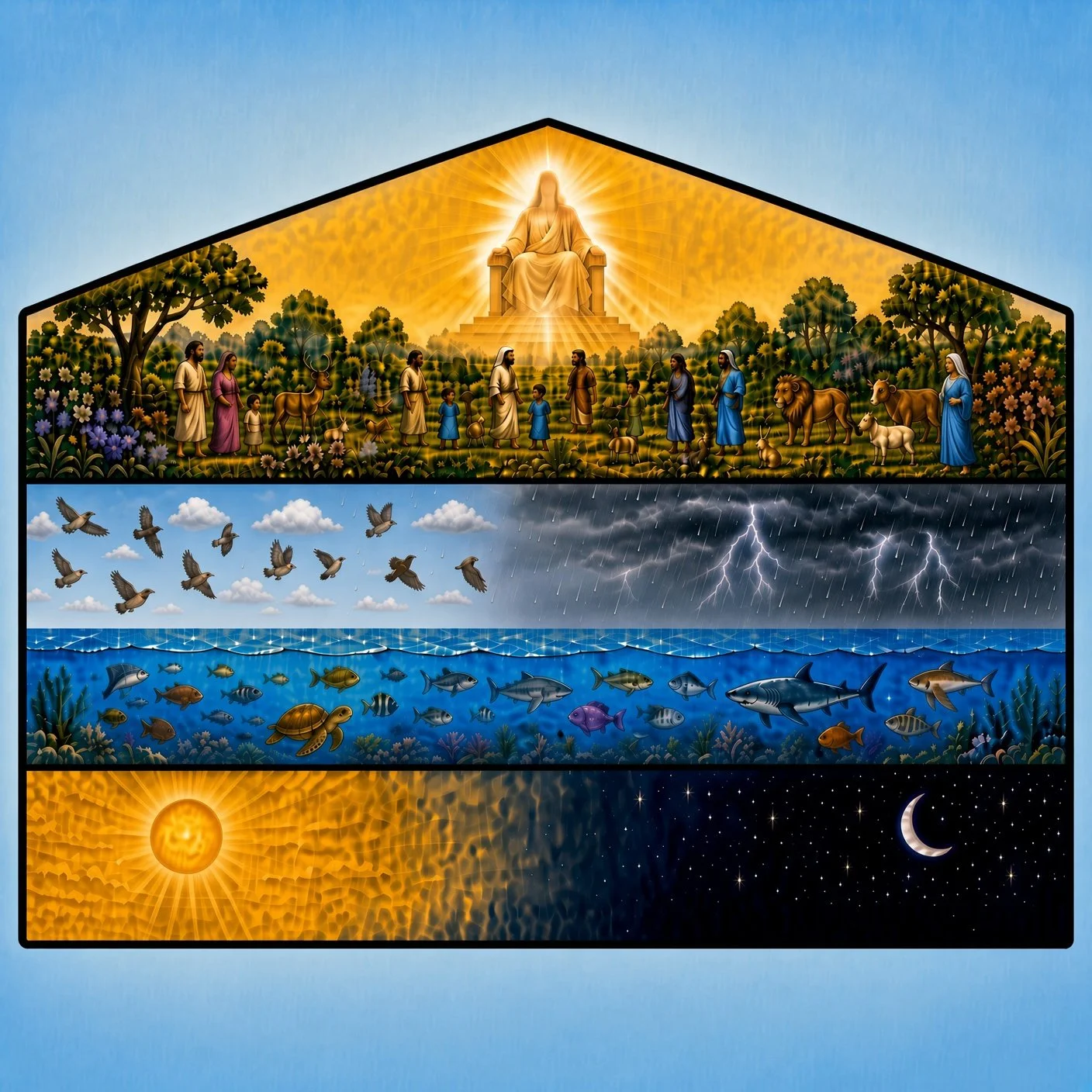
Old Testament scholar, John Walton describes Genesis 1 as the ordering and inauguration of God’s Cosmic Temple in his video, “Reading Genesis 1-2 through Ancient Eyes”. What follows here builds on his work.
God pours out this wisdom like living water from the ABZU as he creates and orders his Cosmic Temple in Genesis 1. The first verse of Genesis declares:
“In the beginning God created (bara) the heavens and the earth.” (Genesis 1:1)
The ancient Hebrew word bara has three meanings in Sumerian which describe what’s occurring in Genesis 1. The first two meanings of bara describe creation as God’s Cosmic Temple where the heavens and earth have been stretched out like a tent to form an enthroned sanctuary for God to dwell with his creatures:
bara₃,₄ = “to stretch or spread out” [bàra, page 39]
bara₂,₅,₆ = “throne dais, seat; king; ruler; sanctum; chamber, dwelling”
This description of heaven and earth as a Cosmic Temple for the throne of God is echoed in Isaiah 40:22 (NIV):
“[God] sits enthroned above the circle of the earth, and its people are like grasshoppers. He stretches out the heavens like a canopy, and spreads them out like a tent to live in.”
The third meaning of bara in Sumerian describes Days 1-6 of creation — “to overflow with abundant differentiation”:
ba-ra₂ = “to overflow with abundant differentiation”
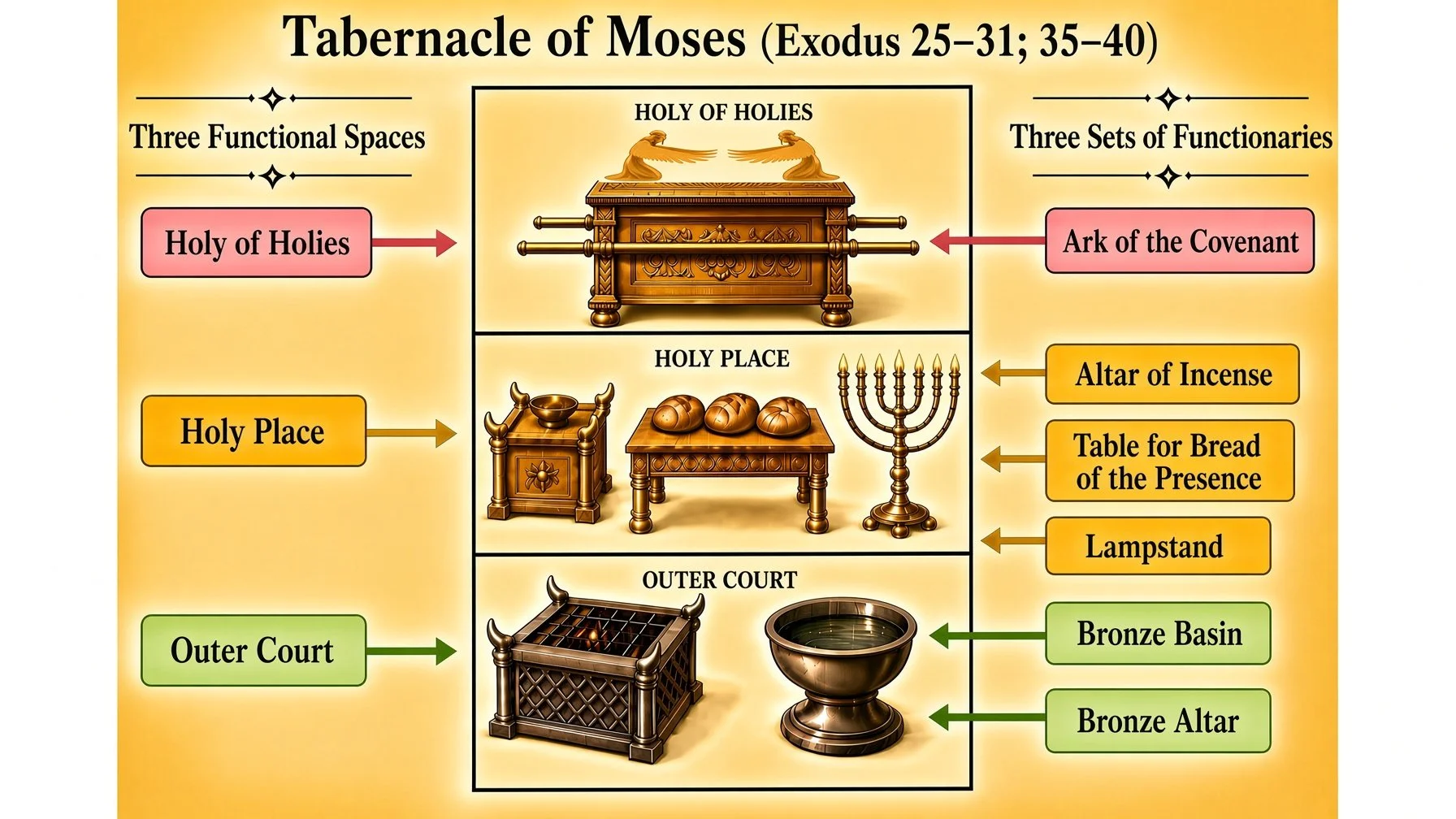
The Cosmic Temple of Genesis 1 is figuratively ordered into a 3-part structure much like the Tabernacle of Moses (Exodus 25–31; 35–40). The tabernacle had three functional spaces — the Outer Court, the Holy Place, and the Holy of Holies. Those spaces were filled with the appropriate functionary objects. The Bronze Basin and the Bronze Altar were placed in the Outer Court for ritual purification and sacrifice. The Lampstand, Altar of incense, and Table were placed in the Holy Place for Aaron and his sons to minister before the Lord. The Ark of the Covenant was placed in the Holy of Holies where the High Priest would enter once a year to serve on the Day of Atonement. In the diagram below, the functional spaces can be seen on the left side of the tabernacle and the appropriate functionary objects for each space is indicated on the right.
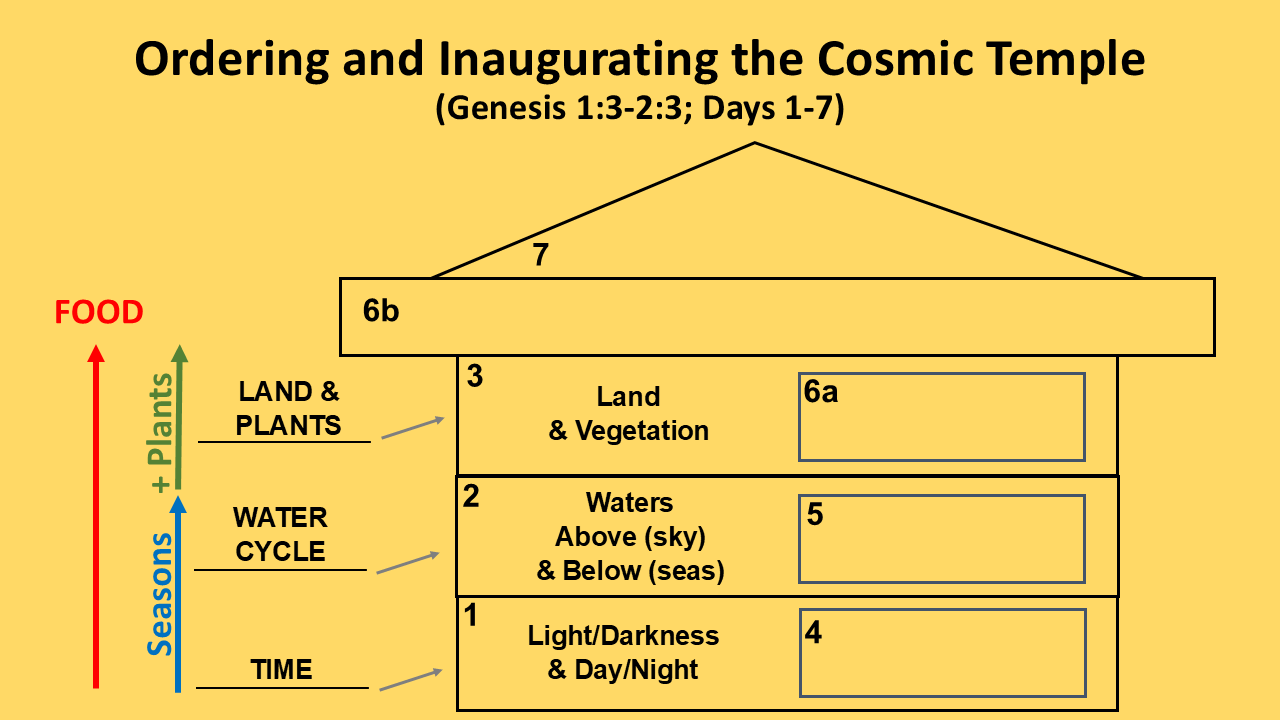
Likewise, the Cosmic Temple is also depicted with a 3-part structure:
Day 1 represents the functional space of Time. [Gen 1:4-5]
Day 2 represents the functional space of the Water Cycle (weather). [Gen 1:6-8]
Day 3 represents the functional space of Land and Plants. [Gen 1:9-13]
Notice that when Time is added to the Water Cycle, it produces Seasons:
Time + Water Cycle = Seasons (cycles of rainfall and river inundation)
Then when Seasons is added to Land and Plants, it produces Food:
Seasons + Land + Plants = Food
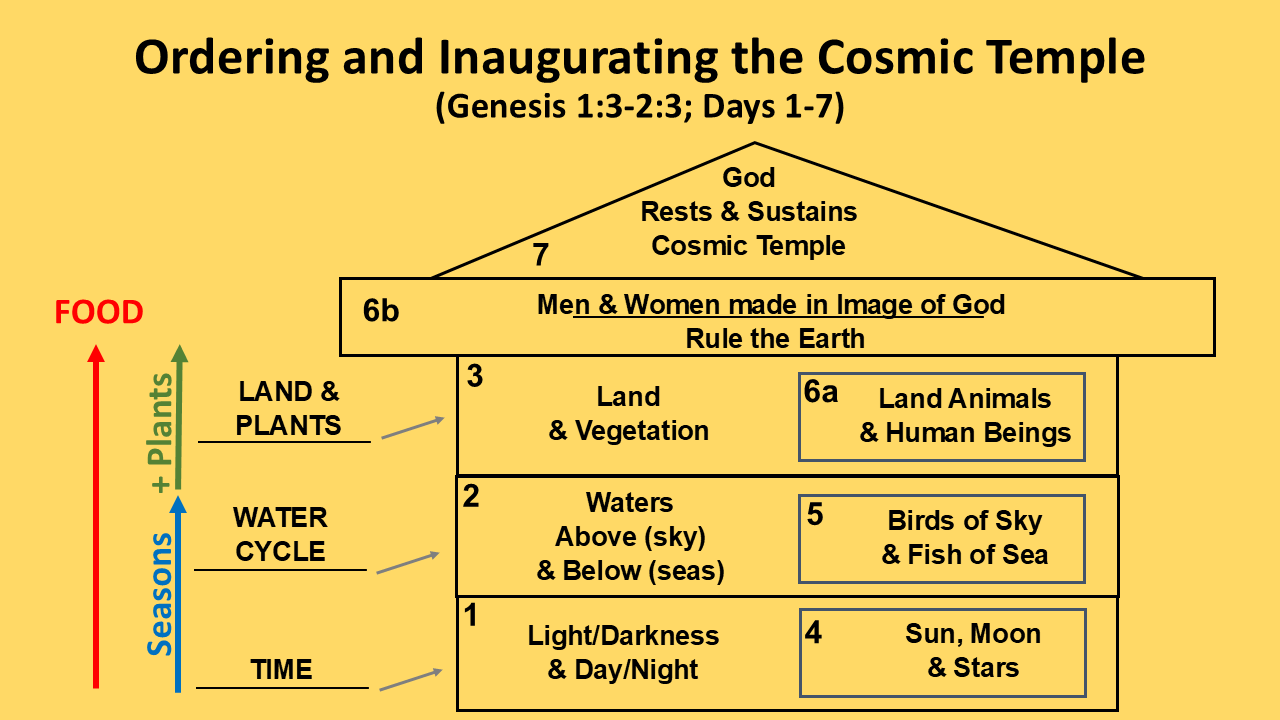
Then Days 4, 5, and 6 depict the appropriate functionary objects being installed in their corresponding functional spaces in order for them to fulfill their purpose:
Day 4 - The sun, moon, and stars are installed as the lights used to tell Time. [Gen 1:14-19]
Day 5 - The birds are placed in the skies above and fish in the waters below because that is where they belong. [Gen 1:20-23]
Day 6 - Land animals and human beings are placed on land among the plant vegetation because that is where they belong. [Gen 1:24-31]
The Cosmic Temple is ordered to provide shelter and sustenance to all creatures and God has come to dwell in relationship with all of creation, sustaining it with providential care (Day 7).
As God orders the Cosmic Temple, he declares: “It is good”. Yet Sumerian reveals that this phrase holds a theological significance that goes beyond mere attractiveness and functionality.
Previous: “Waters of the Deep”