
Sacred Trees of Eden
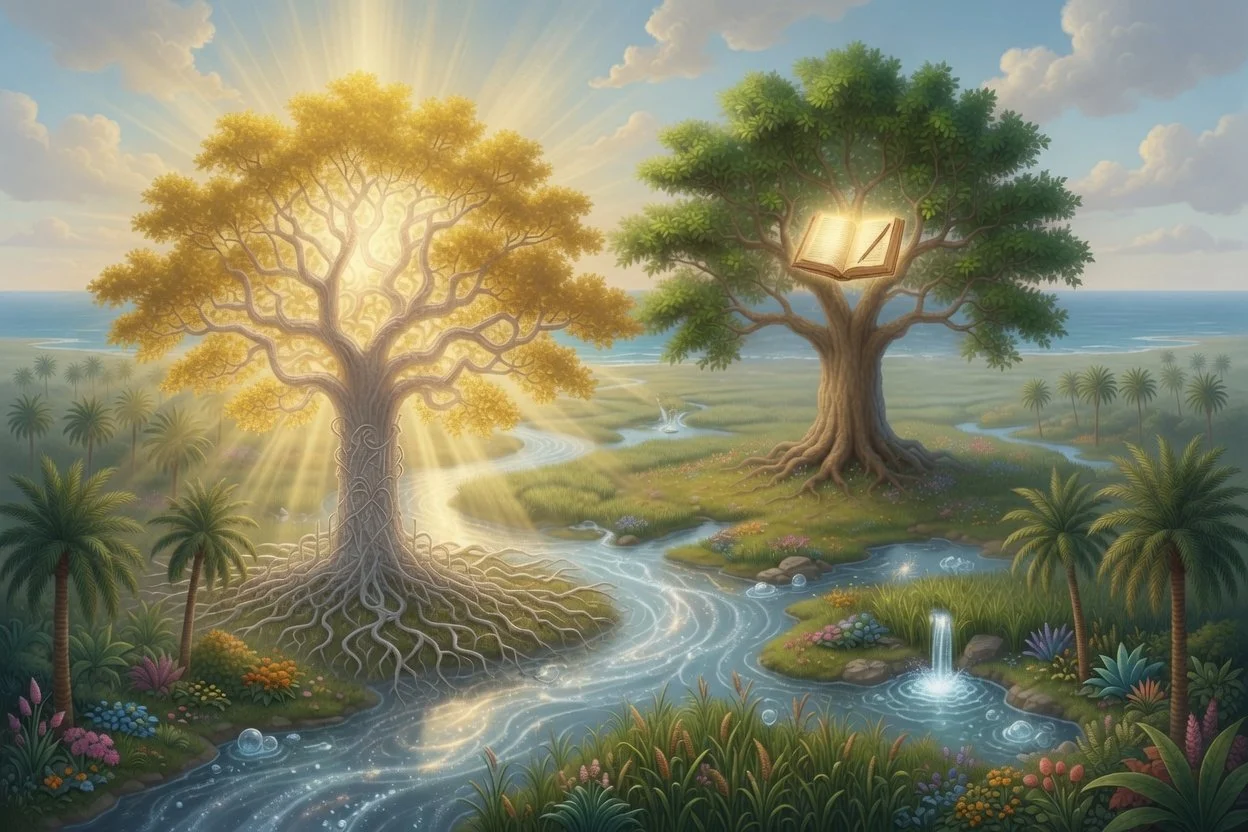
Genesis 2:8-9 depicts God placing the mortal in the sacred space of Eden.
“Now the Lord God had planted a garden in the east, in Eden; and there he put the mortal he had formed. The Lord God made all kinds of trees grow out of the ground —trees that were pleasing to the eye and good for food. In the middle of the garden were the tree of life and the tree of the knowledge of good and evil.”
While Eden was a real geographical location near the head of the Persian Gulf — watered by the Tigris, Euphrates, Karun, and the ancient Kuwait River (Wadi al-Batin), together with the Dammam aquifer — the name itself also carries theological significance. The Hebrew name Eden sounds similar to Sumerian terms associated with pure or life-giving water (e-dan₂,₃,₄,₆ and e-din), suggesting that the garden was understood not only as a physical location but as a symbol of the “water of life”:
e-dan₂,₃,₄,₆ = “pure, clear water”
e-din = “water of life”
e = water
din = tin = (n.) life; (v.) to cure; to be healthy; to live [din, tin, pages 36 and 39]
In the center of this garden, God planted two trees of special significance. The Tree of the Knowledge of Good and Evil represents God’s heavenly wisdom, since the tree belongs to God and stands in his garden. The Tree of Life, in turn, signifies the gift of abundant and enduring life given to those who remain in right relationship with God by following his wisdom — “Life” with God that is enjoyed both in this mortal life and the afterlife.
The two trees in this story would have carried an additional meaning in the Mesopotamian worldview. In Sumerian culture, the term ĝiš-hur (gish-hur) denoted a “plan” or divine design as mentioned in John Halloran’s Sumerian Lexicon [page 104]:
ĝiš-hur = rules, statutes; plan; design; drawing; scheme [ĝiš, 'tool' + ḫur, 'to draw, sketch']
The ĝiš-hur was composed of ancient, holy, and enduring decrees that ensured the protection of civilized life (see ME - pronounced “may”, page 130).
However, because ĝiš can also mean “tree” and hur can mean “ever (again),” the expression is open to a secondary reading as an “everlasting tree”:
ĝiš-hur = “everlasting tree”
The narrative of Genesis appears to have used precisely this kind of wordplay to help hearers of this ancient oral culture remember the story. The two trees in the garden are symbolic embodiments of God’s enduring decrees: his decree of divine wisdom and his decree of life. Such layered meaning is characteristic of both Mesopotamian and biblical wordplay and another example where a single image can sustain more than one significant meaning at once.
Previous: “Priestly Authority and Rulership”