
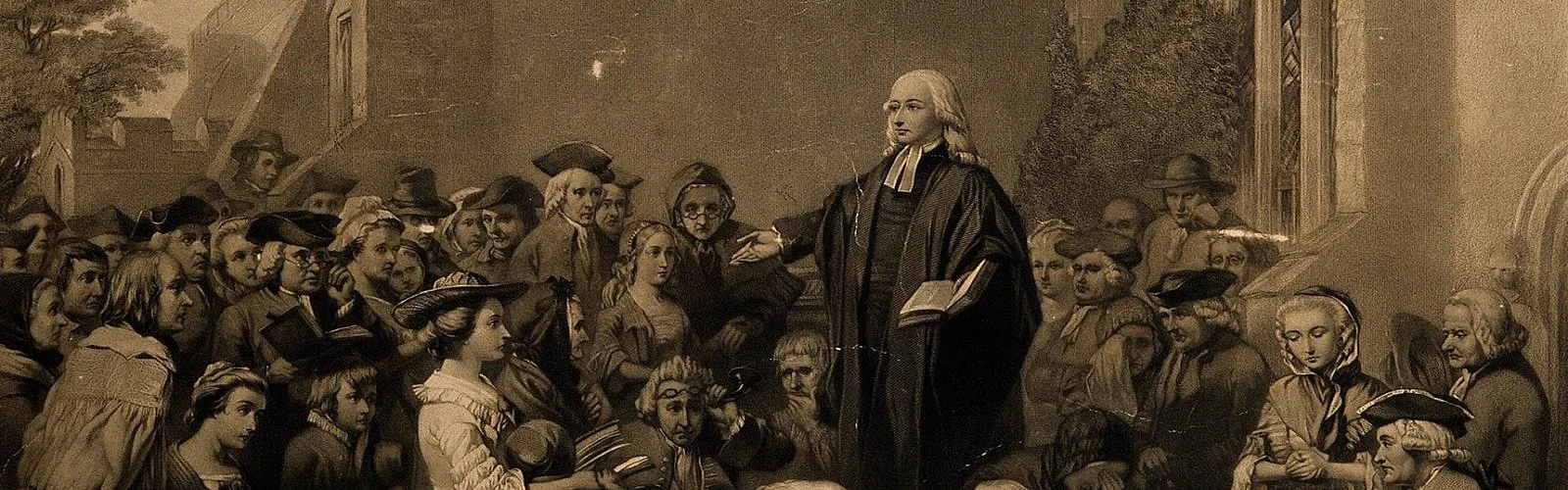
Wesleyan Fidelity to Scripture
John Wesley modeled a way of reading Scripture that remained open to new light from both the Bible and God’s creation. The following article examines how that same Wesleyan fidelity calls the Church to re-examine the doctrine of Original Sin in light of Scripture’s original historical context, modern biblical scholarship, and scientific evidence. It argues that recovering a more faithful reading of Genesis removes unnecessary conflicts between science and Christian faith while strengthening the Church’s witness.
Why the Global Methodist Church Should Reconsider “Original Sin”
Rev. Dr. Victoria Campbell is ordained in the Global Methodist Church and a John Wesley Fellow with AFTE. She holds an MA and PhD in Theology from Asbury Theological Seminary and its doctoral program with the London School of Theology – Middlesex University, as well as a PhD in Chemistry, University of Texas. Victoria is the author of “Understanding Christian Perfection and its Struggle with Antinomianism,” The Problem of Animal Pain, and “Unthinking Old Narratives: Augustinian vs Mesopotamian Paradigms in the Science-Religion Debate.”
At the March 2026 conference of the Wesleyan Theological Society, a panel of respected deans and biblical scholars was asked a simple but important question: “How do we know a Wesleyan biblical interpretation when we see it?” The responses from Brad Kelle, Robert Wall, David Watson, and Renee Dutter Miller highlighted several key features. A Wesleyan reading of Scripture is dialogical: it brings the text’s own socio-historical-linguistic context into conversation with the core Wesleyan themes of holiness and perfect love. It reads Scripture holistically rather than as isolated proof-texts. It honors the Jewish worldview of the Bible —the same worldview held by Jesus, Paul, and the first disciples. And it is willing to bring Scripture into honest dialogue with other domains of knowledge, including science.
These commitments matter because even sincere Christians can misread Scripture when a foreign worldview is brought to the text. The Galileo controversy of the seventeenth century is a sobering example. For centuries, many in the Church taught that the earth stood at the center of the solar system and that this arrangement proved humanity’s importance in God’s plan. Those ideas came not from the Bible itself, but from Aristotelian philosophy. When Galileo offered clear evidence that the earth orbits the sun, many church leaders defended an inherited interpretation rather than asking whether Scripture had been taken out of context to support a Greek cosmology the Bible never taught. It took nearly two hundred years for the Catholic Church to correct that theology, and more than three hundred years to apologize. The lesson still stands: when we force Scripture to fit a worldview that is not its own, we risk distorting God’s Word and wounding the Church’s witness. A better protection is the one Wesleyans already know: read each passage in its own setting and in harmony with the whole of Scripture, rather than lifting verses out of context to support a conclusion we already hold.
Articles of Religion in the Global Methodist Church
Today the Global Methodist Church faces a similar moment. For generations, the Church has read Genesis 1–3 through Greco-Roman “lost paradise” paradigms that are foreign to the text’s original Mesopotamian and Jewish worldview. That reading produced the doctrine that all human beings descended from a single man named Adam who lived about 6,000 years ago and inherited his guilt and a corrupted nature.
The aim of a fresh look is not to empty Genesis of its history or meaning, and it is not to soften the church’s teaching on sin or grace. It is to make room for a more careful reading of the Genesis text itself.
Genesis 4–11 remembers real people in a real place. The evidence gathered here points to Adam and his descendants as historical figures who lived in the time and land of ancient Sumer-Akkad. Genesis 1–3, read with help from that same world and from Sumerian linguistics, functions as a parable about every human being: we are invited into God’s wisdom; we reach for a wisdom of our own; we know the grief of exile from God’s presence.
If that is so, it does not work well theologically to say we inherited guilt from a parable. The parable still tells the truth that matters: we all sin, and we all need grace. Prevenient, convicting, justifying, and sanctifying grace remain in place. Christian Perfection as growth in holy love remains in place. What we are asking is that a later Western reading of Genesis 1–3 not be treated as the only faithful one.
The Jewish community has not accepted inherited Adamic guilt. Recent biblical scholarship situates Genesis in its Mesopotamian context. Modern genetics shows that humanity is far older than six thousand years. Had John Wesley had access to Mesopotamian studies and this scientific evidence, there is good reason to believe he would have looked at Genesis and the later doctrine of Original Sin again. As the Global Methodist Church rearticulates its Articles of Religion and declares Holy Scripture “the primary rule and authority for faith, morals, and service” (BODD ¶104), we now have both the opportunity and the responsibility to examine this long-held tradition with the same spirit of Wesleyan fidelity.
What Makes Interpretation Truly Wesleyan?
John Wesley himself modeled the dialogical, Scripture-centered approach the panel described. He held Scripture as the ultimate authority for faith and life, yet he remained open to new light from the Bible and God’s creation. After his Aldersgate experience in 1738, Wesley radically shifted his understanding of salvation — from prioritizing good works to a joyful trust in God’s fruitful grace. He was also open to scientific discovery. Wesley embraced scientific evidence for Galileo’s heliocentric model, acknowledged that the Church had wrongly interpreted Scripture, and rejected the flawed theology attached to the old view.
That same respect for observation appears in his regard for the empirical method associated with Francis Bacon: observe the world carefully, and do not force nature or Scripture to serve a conclusion already in hand. In his Compendium of Natural Philosophy (1763), he presented the Copernican heliocentric system as the account that best agreed with careful observation. He also noted that this view had long been resisted by prejudice. That matters here. Wesley was willing to let well-tested knowledge of creation correct an inherited interpretation. There is therefore good reason to think he would have displayed the same humility toward newer linguistic, Mesopotamian, and scientific light on Genesis.
Wesley demonstrated this same humility before Scripture when correcting long-standing misunderstandings about Christian perfection. For centuries, Western Christians had read Jesus’ command “Be perfect” (Matthew 5:48) through the Latin word perfectio, suggesting a state of complete infallibility. Wesley, however, turned to the Greek word teleios, meaning “whole, complete, mature.” He saw Christian perfection not as a static state of sinless perfection but as a dynamic process of growing in love — maturing into the likeness of Christ. If he was willing to correct centuries of Latin-influenced thinking when better insight from the original language emerged, the same humility belongs to our reading of Genesis.
This adaptive spirit defines genuine Wesleyan interpretation. When fresh biblical scholarship or scientific evidence challenges older readings, Wesleyans do not cling to tradition for its own sake. We return humbly to Scripture in its original context and ask how best to understand God’s Word for our time.
How a Lost-Paradise Reading of Genesis Took Hold
For many Christians, the doctrine of “Original Sin” feels as if it has always been part of the Bible. A careful reading of Scripture in its original Jewish context suggests something more modest. The later package often called Original Sin — inherited guilt, a ruined creation, total depravity from birth, and biological death entering the world through one man’s act — is difficult to find in the Hebrew Bible or in the Jewish world of Jesus and the apostles.
Judaism has never accepted the inheritance of Adam’s sin, total depravity, or inherent sinfulness in children. Scripture explicitly states that sin cannot be inherited (Ezekiel 18:1-32) and it arises from broken relationships with God and others. The Jewish view of human nature holds that we possess two inclinations—yetzer tov (good inclination) and yetzer ra (evil inclination)—but God’s grace and wisdom enable us to choose good over evil. This teaching is confirmed by the biblical witness of Moses, Proverbs, and Jesus where humans are instructed to choose God’s wisdom and the ways of righteousness over earthly wisdom and its sinful ways (Deuteronomy 28–30; Proverbs 1–9; Matthew 5–7).
Children, being too young to possess full wisdom and discernment, were not held accountable for sin until they reached puberty. Jewish rabbis taught that the soul enters the world free from sin and transgression; a child’s foolishness was viewed as immaturity rather than moral guilt. This perspective explains why Jesus elevated children as models of innocence and kingdom readiness (Matthew 18:1–10; 19:14), never as embodiments of sin or total depravity.
Furthermore, the Jewish worldview affirmed that God created a “very good” world (Genesis 1), a conviction powerfully expressed through God’s providential care for creation in Job 38–41 and Psalm 104. This directly contradicted pagan dualism’s claim that the material world is inherently corrupt. It is why Paul never taught a fallen creation; instead, he pointed to the created order as evidence of God’s invisible qualities, eternal power, and divine nature (Romans 1:20).
So where did this teaching come from? It developed as the Greco-Roman worldview began reshaping how people read Genesis. In the ancient Greek world, popular stories told of a perfect “golden age” lost by human failure. Lost paradise paradigms were shaped by Hesiod’s Pandora’s Jar (ca. 700 BCE; II. 42-105)and Myth of the Races (II. 106-201), Plato’s Timaeus (ca. 400 BCE), and Greek dualism. The reigning paradigm of Plato—which later influenced Augustine and other Church Fathers—was that a perfect God would never create suffering or death, making the material world a corrupted version of the ideal. Consequently, these pagan concepts of a “lost paradise” became widely familiar across the Mediterranean world.
Then, when the Hebrew Bible was translated into Greek (the Septuagint, ca. 250 BCE), a small but significant change occurred. The Hebrew terms ha-adam/adam (referring to “the human/humans”; Gen 1:26–27) were frequently rendered as the proper name “Adam.” This encouraged Greek-speaking readers to think of Genesis 2–3 as the story of one specific individual rather than a universal archetype of humanity. Subsequently, from 200 BCE to 100 CE, non-canonical writings began blending Greek ideas with the Genesis account, blaming Adam and Eve for losing a deathless paradise (Sirach 25:24; Wisdom of Solomon 1:13–16, 2:23–24; Apocalypse of Moses; 4 Ezra; 2 Baruch).
Paul’s Strategic Engagement with the Hellenized World
One of the greatest obstacles for Western Christians is that we think we already understand what Paul means when he uses Adam. In practice, we often hear only the Gentile interpretation Paul used. We are far less familiar with the Jewish Adam he was also using. Both hearings are present in his letters. If we keep only one, we will misread him.
Paul did not require Gentiles to be circumcised, to keep the food laws, or to take on the full observance of Torah. It is fair, then, to assume he also did not require them to abandon a Hellenized worldview for a Jewish one, or to replace their ancestral understanding of Adam with the archetypal Adam of Jewish tradition. His aim was not to make Gentiles into Jews. His aim was to make Jews and Gentiles one in the body of Christ.
Paul knew he had to address a church in which these two groups held opposing worldviews and often held one another in contempt rather than uniting in the love of Christ. He understood the Scriptures as a Pharisee. He also understood Gentile philosophies and habits of thought. That is why he can quote Stoic and Epicurean language, pagan poets, and other cultural images Gentiles already knew, “taking captive every thought to make it obedient to Christ” (2 Corinthians 10:5). He would also have known the non-canonical “Fall” readings shaped by Hellenized writers, which treated Genesis 1–3 as an account of how biological death began, much as Greek lost-paradise stories had done.
This is where Paul’s wisdom as an evangelist is most clear.
In Romans and in 1 Corinthians 15, Paul joins Adam, sin, death, and Christ. Jewish hearers could receive Adam as an archetype of every human being’s turn from God’s wisdom. In that Jewish understanding, “death” is also relational separation from God. So Paul can proclaim, truly, that Jesus’ sacrificial death atones for sin and restores repentant sinners to Life with God.
Gentile hearers often had little patience for Jewish law or Jewish ways of speaking about sin. What they did feel was the fear of biological death and the hope of a life beyond it. Many already regarded Adam as their first ancestor, and his sin as the reason they die. Paul knew that Jesus had been raised bodily, and that those who belong to him will be raised from the dead. So he can also proclaim, truly, that all who put their faith in Christ will share his resurrection and blessed eternal life.
Jews and Gentiles could therefore hear Paul’s words about Adam differently and still be brought together in Christ. However, the later church often kept only the Gentile ancestral reading and lost sight of the Jewish archetypal reading. That is one reason Christians who love Jesus now divide over whether every human being must be descended from one couple about 6,000 years ago.
The two genealogies of Jesus show the same pastoral difference. Matthew writes his Gospel for hearers formed by Israel’s story. He traces Jesus to Abraham because that is the line of promise the Jewish people already know they belong to. They do not need a line to Adam in order to see why Jesus is theirs, and they know they do not inherit Adam’s guilt. Luke writes his Gospel with Gentile hearers in view. They have no inheritance in Abraham and no share in the Law by birth. Since many think of Adam as their first ancestor and the reason they die, Luke carries Jesus’ line to Adam so that they can see their own need — and their own salvation — in Christ. Otherwise a Gentile might wonder why a “Jewish Messiah” had anything to do with a Gentile at all.
The point in both Luke and Matthew’s Gospels, and in Paul’s letters, is Christ. We do not honor that missionary wisdom by freezing only one understanding of Adam into our unalterable Articles of Religion.
The Hellenized Reading Takes Hold: The Church Fathers & Augustine
By the fourth and fifth centuries, a “paradise lost” reading of Genesis had become dominant in much of the Western Church. Teachers such as Basil of Caesarea and Augustine of Hippo developed interpretations in which Adam and Eve’s sin corrupted creation and brought thorns, sickness, and biological death into the world about 6,000 years ago. Yet inherited guilt from Adam and a deathless lost paradise receive little support from Genesis 4 to Malachi, even though sin is addressed throughout the Old Testament.
We should admire Augustine. He defended grace when Pelagius made too little of it. The church is in his debt. We have listened less well to Augustine when he warned that his own reading of Genesis was not final.
Not knowing Hebrew, he could not work from the Hebrew text. The Latin Bible he used, like the Greek Septuagint before it, often treated ha-adam / adam in Genesis 1–3 as a proper name more quickly than the Hebrew invites. He also said he struggled to decide whether particular passages should be taken figuratively or literally, spiritually or materially, allegorically or historically. He wrote:
“With these facts in mind, I have worked out and presented the statements of the Book of Genesis in a variety of ways according to my ability; and, in interpreting words that have been written obscurely for the purpose of stimulating our thought, I have not rashly taken my stand on one side against a rival interpretation which might possibly be better.” (The Literal Meaning of Genesis 1.20.40)
And:
“In matters that are obscure and far beyond our vision, even in such as we may find treated in Holy Scripture, different interpretations are sometimes possible without prejudice to the faith we have received. In such a case, we should not rush in headlong and so firmly take our stand on one side that, if further progress in the search of truth justly undermines this position, we too fall with it. That would be to battle not for the teaching of Holy Scripture but for our own, wishing its teaching to conform to ours, whereas we ought to wish ours to conform to that of Sacred Scripture.” (The Literal Meaning of Genesis 1.18.37)
Augustine did not claim that his interpretation of Genesis was infallible. With the linguistic, Mesopotamian, and scientific light available to interpreters today, he would have hesitated to write one settled reading of Adam into the church’s unalterable Articles of Religion. We can follow that caution even where earlier tradition did not.
We can still say that Pelagius was wrong about grace. We can still say that every morally responsible person sins and needs Christ. We do not need inherited guilt from Genesis 1–3 in order to say those things.
There are also places where the Western formulation of Original Sin sits in tension with the biblical canon. Ezekiel 18 spends a whole chapter rebutting the claim that children inherit a parent’s guilt. Exodus 20 speaks of consequences to the third and fourth generation of those who hate God, and of steadfast love to a thousand generations of those who love him — not of a perpetual curse on every infant. Psalm 51 is David’s confession after his sin with Bathsheba and against Uriah; it is less clear that one man’s penitential cry should become the measure of every child (Psalm 51:5). Psalm 8 still says God made human beings “a little lower than the angels,” which sits more easily with Genesis 1:26–28 than with a humanity already ruined in the womb. “There is no one righteous, not even one,” used as hyperbole in Romans 3, takes up Psalm 14, a psalm about the fool who says there is no God — and that same psalm speaks of God’s presence among the righteous in the fifth verse. Scripture also names people as righteous: Abel, Zechariah son of Berekiah, Noah, Abram, Lot, Job, Zechariah and Elizabeth, John the Baptist, and Simeon (Matt 23:35; Gen 6:9; 15:6; 2 Pet 2:7; Job 1:8; Luke 1:5–6; Mark 6:20; Luke 2:25).
The point is not to diminish Augustine or the early teachers who were trying to defend the faith. They were reading Genesis through a Greco-Roman frame that was not native to the text’s Mesopotamian and Jewish world. In time, the lost-paradise tradition came to be treated as if it were the plain teaching of Scripture itself. Given the Global Methodist Church’s commitment to Scripture as its highest authority, we should be slow to place in our unalterable Articles of Religion an interpretation that sits in such tension with the explicit teaching of the biblical canon.
Reading Genesis 1–3 in Its Original Mesopotamian Context
When biblical scholars such as John Walton help us read Genesis 1–3 within its ancient Mesopotamian worldview, the text presents a very different story from the traditional Augustinian interpretation.
Genesis 1 portrays creation as a great Cosmic Temple where God dwells in communion with his creatures. The chapter describes the order and provision of creation rather than a scientific timetable of how God created. God crowns male and female human beings as rulers and stewards of this temple. Genesis 2 then answers the question of why God entrusted human beings with this responsibility: because God shares his divine wisdom with them. Those who live by God’s wisdom will receive life—both covenantal blessing and eternal life—but those who grasp equality with God by following their own wisdom face expulsion from sacred space and relational death (Genesis 3). Thus, in the Jewish tradition of Paul’s day, Adam was understood primarily as a literary archetype of humanity, not its biological progenitor.
The central tragedy of Genesis 3 is relational death—broken fellowship with God—rather than biological death. Mortality was already a baseline reality of God’s good creation, signified by humanity’s metaphorical formation from “dust,” a common Mesopotamian symbol for mortality. “Death” often functions as a Jewish metaphor for broken relationship with God, both in this life and the afterlife. Paul employed this metaphor when addressing living believers: “You were dead (corpses) in your transgressions and sins” (Ephesians 2:1).
Likewise, when Scripture calls Eve “the mother of all the living” (Gen 3:20), it uses a Mesopotamian idiom referring to the first person to do some special new thing—in this case, live in right relationship with God and follow his wisdom. The same idiom appears with Jabal and Jubal, who are described as the “father” of those who live in tents and raise livestock and the “father of all” those who play musical instruments (Gen 4:20–21). In Romans 4:11, Paul also uses this idiom to describe Abraham as “the father of all” who believe but have not been circumcised. Therefore, the text is not claiming Eve is the biological mother of all human beings any more than it is suggesting Jabal and Jubal are genetically related to all cowboys and musicians, or Abraham was related by blood to the believing Gentiles.
Why Enshrining One Reading of Genesis Would Be Unwise
If the Global Methodist Church incorporates the later Western formulation of Original Sin into its unalterable Articles of Religion, it would make several things harder than they need to be.
First, it would risk elevating a later interpretation above the primary authority of Scripture, placing the Articles in tension with passages that speak against inherited guilt.
Second, it would create lasting and unnecessary conflicts with science. Genetic evidence shows that humanity is hundreds of thousands of years old and did not descend from a single pair who lived about six thousand years ago. The fossil record shows that thorns and biological death existed long before humans. Tying the authority of Scripture to biological claims the text itself does not make can make the Bible appear unscientific to people already wrestling with faith.
Third, it would require faithful Christians to affirm claims about human origins that sit in tension with genetic evidence and that grew from Hellenistic frames rather than from the text’s own thought-world.
Fourth, it would fix a Greco-Roman lost-paradise frame in our doctrinal standards—the very kind of imported paradigm that Wesleyan interpretation is meant to challenge and test against Scripture.
Finally, it can quietly shift attention away from Jesus’ positive call to love toward a view of the human being that has little room for the dignity of humanity that Scripture also teaches.
A Better Way — Defining Sin by Jesus’ Two Greatest Commandments
None of the Normative Documents of the Global Methodist Church (BODD ¶105)—the Apostles’ Creed, Nicene Creed, and Definition of Chalcedon—endorse the doctrine of Original Sin. They do, however, declare that our Lord Jesus Christ is the eternal Logos and Wisdom of God made flesh, the only Son of God the Father. Jesus’ teaching should therefore carry ultimate authority for how we understand sin, not Augustine’s.
Jesus declared that the two greatest commandments—to love the Lord our God with all our heart, soul, mind, and strength, and to love our neighbor as ourselves—sum up the entire Law, the Prophets, and lead to eternal life. The Global Methodist Church should therefore define sin as any failure—by thought, word, action, or inaction—to obey these divine commands to love. This approach harmonizes with the whole of Scripture, Wesleyan understandings of grace, and the Jewish view of humanity’s inclinations for both good and evil. It resonates with Wesley’s doctrine of Christian perfection as maturing in agape love, removes unnecessary conflicts with science, spares future generations from having to affirm theological claims that are biologically untenable, and centers Jesus’ own summary of God’s will in our doctrinal standards.
Conclusion
The Global Methodist Church stands at an important moment. We have declared Scripture our highest authority and committed ourselves to a Wesleyan reading that honors the Jewish roots of our faith. Fresh Mesopotamian scholarship and scientific evidence on human origins now invite us to do what Wesley himself modeled: return humbly to Scripture, listen to new light from God’s Word and God’s world, and correct an earlier misunderstanding where the text requires it.
We are not asking the church to teach that sin is small. Genesis 1–3, heard as a parable of us all, still says that we turn from God’s wisdom. Genesis 4–11 still remembers a real human story in a real land. Grace still finds us there. Prevenient, convicting, justifying, and sanctifying grace remain in place. Christian Perfection as growth in holy love remains in place.
Removing the later Augustinian concepts of the Fall, Original Sin, and Total Depravity from our Articles of Religion does not weaken our doctrine of sin. It sharpens it and returns us to the relational heart of the gospel: humanity’s broken relationship with God and God’s gracious restoration through Jesus Christ. This change supports our proclamation of holiness as agape love, the heart of Wesley’s message and of the two greatest commandments of our Lord.
The invitation is only this: let our Articles say what Jesus said about love and sin, so that Scripture can keep teaching us as better light on Genesis arrives. Let us have the courage and humility to follow Scripture wherever it leads. In doing so, we will strengthen our witness, deepen our love for God and neighbor, and remain faithful to the Wesleyan heritage we hold dear.