
Augustine’s Cautions on Genesis
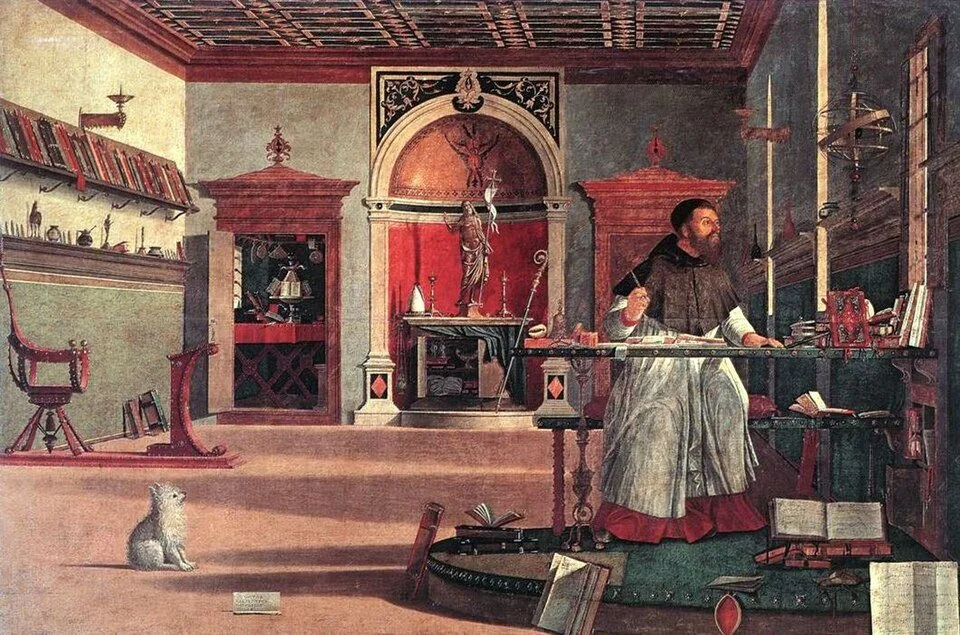
[Image: “Vision of Saint Augustine”, Vittore Carpaccio (c. 1502)]

The Western tradition of the church has sometimes treated Augustine’s reading of Genesis as more settled than Augustine himself claimed it was. He repeatedly acknowledged how hard it was to know whether particular passages should be taken figuratively or literally, spiritually or materially, allegorically or historically. Reflecting on that struggle, he wrote:
“With these facts in mind, I have worked out and presented the statements of the Book of Genesis in a variety of ways according to my ability; and, in interpreting words that have been written obscurely for the purpose of stimulating our thought, I have not rashly taken my stand on one side against a rival interpretation which might possibly be better.”
(The Literal Meaning of Genesis, 1.20.40)
He also issued a clear caution against forcing preferred interpretations of Scripture into conflict with established knowledge of the natural world. His words sound severe, but his concern was pastoral—that shallow or forced readings of difficult passages might make the Christian message look foolish and turn people away from the wisdom and salvation it offers:
“Usually, even a non-Christian knows something about the earth, the heavens, and the other elements of this world, about the motion and orbit of the stars and even their size and relative positions, about the predictable eclipses of the sun and moon, the cycles of the years and the seasons, about the kinds of animals, shrubs, stones, and so forth, and this knowledge he holds to as being certain from reason and experience.
“Now, it is a disgraceful and dangerous thing for an infidel to hear a Christian, presumably giving the meaning of Holy Scripture, talking nonsense on these topics; and we should take all means to prevent such an embarrassing situation, in which people show up vast ignorance in a Christian and laugh it to scorn. The shame is not so much that an ignorant individual is derided, but that people outside the household of the faith think our sacred writers held such opinions, and, to the great loss of those for whose salvation we toil, the writers of our Scripture are criticized and rejected as unlearned men.
“If they find a Christian mistaken in a field which they themselves know well and hear him maintaining his foolish opinions about our books [of Holy Scripture], how are they going to believe those books in matters concerning the resurrection of the dead, the hope of eternal life, and the kingdom of heaven, when they think their pages are full of falsehoods on facts which they themselves have learnt from experience and the light of reason?”
(The Literal Meaning of Genesis, 1.19.39)
Therefore, Augustine himself recognized that his interpretation of Genesis was not infallible. Consequently, he cautioned that if a better interpretation came along when additional information was available, the church should not resist it if it maintained the central components of the Christian faith:
“In matters that are obscure and far beyond our vision, even in such as we may find treated in Holy Scripture, different interpretations are sometimes possible without prejudice to the faith we have received. In such a case, we should not rush in headlong and so firmly take our stand on one side that, if further progress in the search of truth justly undermines this position, we too fall with it. That would be to battle not for the teaching of Holy Scripture but for our own, wishing its teaching to conform to ours, whereas we ought to wish ours to conform to that of Sacred Scripture.”
(The Literal Meaning of Genesis, 1.18.37)
The church is again in a season when older assumptions about Genesis may be tested against clearer light. With the same reverence for Scripture and its message of salvation that Augustine urged, we can receive what is coming into view without fear.
A better interpretation is taking shape as Genesis is resettled in its original Mesopotamian and Jewish world. Geological, geographical, botanical, biblical, and linguistic evidence points to Adam and his descendants as historical people who lived in the time and place of ancient Sumer-Akkad. Genesis 1–3, read in that setting, functions as a pedagogical story about every human being invited into God’s wisdom—and prone to replace it with our own. The evidence and story are offered here: Genesis 1–11: Historical Memory of Sumer-Akkad.
Paul’s use of Adam shows a similar pastoral concern in Romans and 1 Corinthians 15. When he joins Adam, sin, death, and Christ, he is speaking to a mixed audience of Jews and Gentiles at once. Jews viewed Adam as an archetype of human failure and relational “death” separating us from God. Gentiles understood Adam as their ancestor and the reason for the existence of biological death. Yet Paul was able to use these different understandings of Adam to unite Jews and Gentiles together in Christ.
We should not dismiss Augustine. We should do what he asked: not treat one interpretation of Genesis as if it were the source of salvation itself. The focus of our faith should forever remain on the Gospel message—wisdom, repentance, and life with God in Jesus Christ.