
Nakedness, Repentance, and Restoration
Throughout Scripture, God’s judgment is tempered with grace. This is seen as we follow the issue of “nakedness” in the Genesis story.
Initially, when God placed the mortal and its wife in Eden, they “were both naked and they felt no shame” (Genesis 2:25). But then after they sinned by grasping equality with God, eating the forbidden fruit, and following earthly wisdom instead of God’s heavenly wisdom:
“The eyes of both of them were opened, and they realized they were naked; so they sewed fig leaves together and made coverings for themselves.
Then the mortal and its wife heard the sound of the Lord God as he was walking in the garden in the cool of the day, and they hid from the Lord God among the trees of the garden. But the Lord God called to the mortal, ‘Where are you?’
He answered, ‘I heard you in the garden, and I was afraid because I was naked; so I hid.’
And [God] said, ‘Who told you that you were naked?’” (Genesis 3:7-11)
This conversation raises two questions. First, what does nakedness represent in this story? Second, why were the mortal and its wife initially unashamed of their nakedness, but then tried to hide their nakedness in fear of God once they sinned?
In “By the Sweat of Your Brow: Adam, Anat, Athirat, and Ashurbanipal”, Assyriologist and biblical scholar Daniel Fleming explains that nakedness indicates vulnerability, humility, and helplessness in the Bible:
Like a naked newborn baby, nakedness implies helplessness (Ezekiel 16:4-6).
All humans are born naked and leave the earth the same way, stripped of power, rank, and wealth (Job 1:21).
Clothing implies protection and its removal can signify protection that is removed (Ezekiel 16:8; Hosea 2:3, 9).
Those who lose in battle are stripped naked, humiliated, and impoverished (Deuteronomy 28:48; Isaiah 20:2-4; 47:3; Lamentations 1:8; Amos 2:16; Nahum 3:5).
In Genesis 2:25, the mortal and its wife were naked and unashamed, because they knew they were helpless but understood that they were protected by the wisdom, provision, and love of God. So, when they remained in right relationship with God, they accepted their dependency on God with humility and reciprocated love.
It is then ironic that the serpent spoke accurately, but duplicitously, when it said, “When you eat from [the Tree of Knowledge of Good and Evil] your eyes will be opened, and you will be like God, knowing good and evil,” (Genesis 3:5).
Once the pair ate the forbidden fruit in their grasp for equality with God and their eyes were opened, they realized they could never be like God. They were utterly helpless and dependent on everything God had done for them. Having sought self-sufficiency, they now saw that without God they were powerless.
This knowledge of their foolish pride and vulnerability drove them to sew absurdly inadequate coverings from fig leaves and hide from God in the garden. Having lost the battle with the serpent, they recognized they were naked, humiliated, and had forfeited God’s sacred space.
However, the grace God displays towards the mortal and its wife is often underemphasized.
In Genesis 3:8-13, the two confess their sins to God — they:
abandoned the wisdom of God,
listened to the false teacher,
disobeyed God and ate the forbidden fruit,
grasped equality with God, and
hid from God in shame.
While there are consequences that follow, there is also restoration. After their confession of repentance, God lovingly restores the mortal and its wife in enduring priestly garments of leather:
“And the LORD God made priestly garments (ketonot) of leather (or) for Adam and his wife, and clothed them.” (Genesis 3:21)
Although Genesis 3:21 is often translated, “The LORD God made garments of skin…”, this overlooks the fact that the Hebrew word ketonot (“garment/tunic”) selected here is most often used in Scripture to refer to priestly or royal robes (Nehemiah 7:70; Exodus 28:4, 39-40; 29:5-8; 39:27; 40:14; Leviticus 8:7-13; 10:5; 16:4; Ezra 2:69). Consequently, the stature and office associated with these garments would be more accurately conveyed as “priestly garments of leather” than “garments of (animal) skin”, which implies a primitive state of destitution to the contemporary reader.
In other words, the language of the text in Genesis 3:21 indicates that God forgives repentant mortals who put their full trust in him and he covers their helplessness with priestly garments of salvation.
This interpretation is consistent with the image of our forgiving God that is depicted throughout Scripture. Furthermore, the detail that the priestly robes are leather likely signifies the strength and endurance of humanity’s priestly designation and anointing to rule the earth (Gen 1:26–28).
Ultimately, the robes of righteousness that God supplies are provided by the timeless atoning sacrifice of Jesus Christ — the Lamb of God — who redeems mortals from eternal debt-slavery to the Father of Lies (John 8:44; John 1:29; Isaiah 43:1; 61:10; Galatians 3:26-27; Revelation 19:6-8).
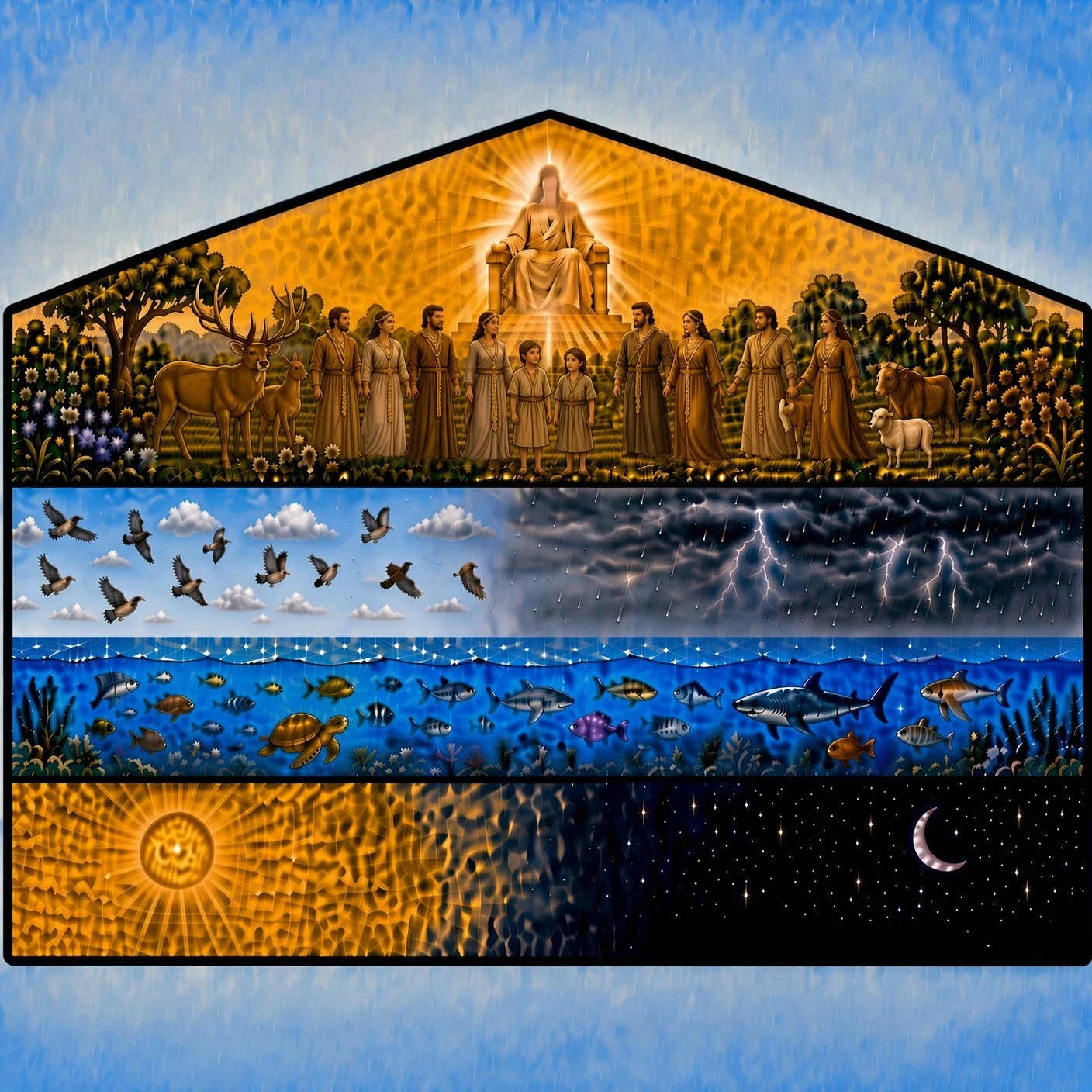
Genesis 1 depicts creation as the Cosmic Temple where God dwells with his creatures and sustains them in his providential care. All mortals, male and female, are made in the image of God and are entrusted with the stewardship and rule of creation and its creatures.
Genesis 2 proclaims that mortals have been entrusted with the priestly role of protecting and imbibing the “water of life” which contains God’s wisdom. God has given mortals wisdom as wife and helpmate to protect sacred space and ultimately lead them to Life — right relationship with God in this life and the afterlife.
Genesis 3 warns mortals that they will be tempted to abandon the wisdom of God and the “water of life” by false teachers. Earthly wisdom will deceive mortals and their wisdom into abandoning heavenly wisdom and seizing equality with God. When they succumb to false teaching and disobey God, they will experience relational death – separation from God in this life and the afterlife – as they replace God’s wisdom with their own. Yet, when sinners repent and confess their sins, God in his mercy and grace forgives and restores them to their priestly role of sharing God’s wisdom and his gift of “Life”.
Historical Adam & Eve
As the pedagogical story ends and transitions to the historical family that passed down the wisdom of God that leads to Life, it explains why the woman called Eve would become “the mother of all the living” (Genesis 3:20).
Just as the Bible uses “Death/dying” as a metaphor for those who abandon the wisdom of God, “Life/living” is a metaphor describing those who embrace and live according to God’s wisdom. Likewise, the Hebrew scriptures teach the “living” are those who remain in covenantal relationship with God whereas the “dead” are those who break relationship with God and are expelled from God’s presence. Accordingly, Paul called his living listeners necrotic corpses when he said, “You were dead (nekrous) in your transgressions and sins” (Ephesians 2:1).
Importantly, the phrase “the mother of all” or “father of all” is an ancient idiom referring to the first person to do some special new thing — in the case of Eve, she was the first to live in right relationship with God and follow his wisdom.
The same idiom is used again in Genesis 4:20-21 to describe Jabal as the “father” of those who live in tents and raise livestock and Jubal as the “father of all” those who play musical instruments.
Paul also uses this idiom as he teaches that Abraham “is the father of all who believe but have not been circumcised” (Rom 4:11).
Therefore, interpreters need to understand that the Genesis text is not claiming Eve is the biological mother of all human beings on the planet any more than it is suggesting that Jabal and Jubal are the genetic ancestors of all cowboys and musicians, or that Abraham is the bloodline father of all uncircumcised Gentiles who put their faith in Christ. Rather, Eve is being honored by her husband, who recognizes that she will be the first to live according to the wisdom of God.
Eve’s husband is the historical Adam (c. 4000 BCE) in ancient Sumer who became the father of Cain, Abel, and Seth:
ad-am₃ = “to be a father”, [Genesis 4:1-2, 25]
Adam passed this pedagogical story down to his descendants so they would understand the importance of embracing and living out the wisdom of God. Genesis 1—3 explains why the rest of Scripture is devoted to teaching God’s wisdom, reconciling and restoring broken relationship between God and humanity, and bringing those dead in sin back to Life in God.
Previous: “Consequences of Earthly Wisdom”