
The Rib:
God Changes Mortality
into Eternal Life
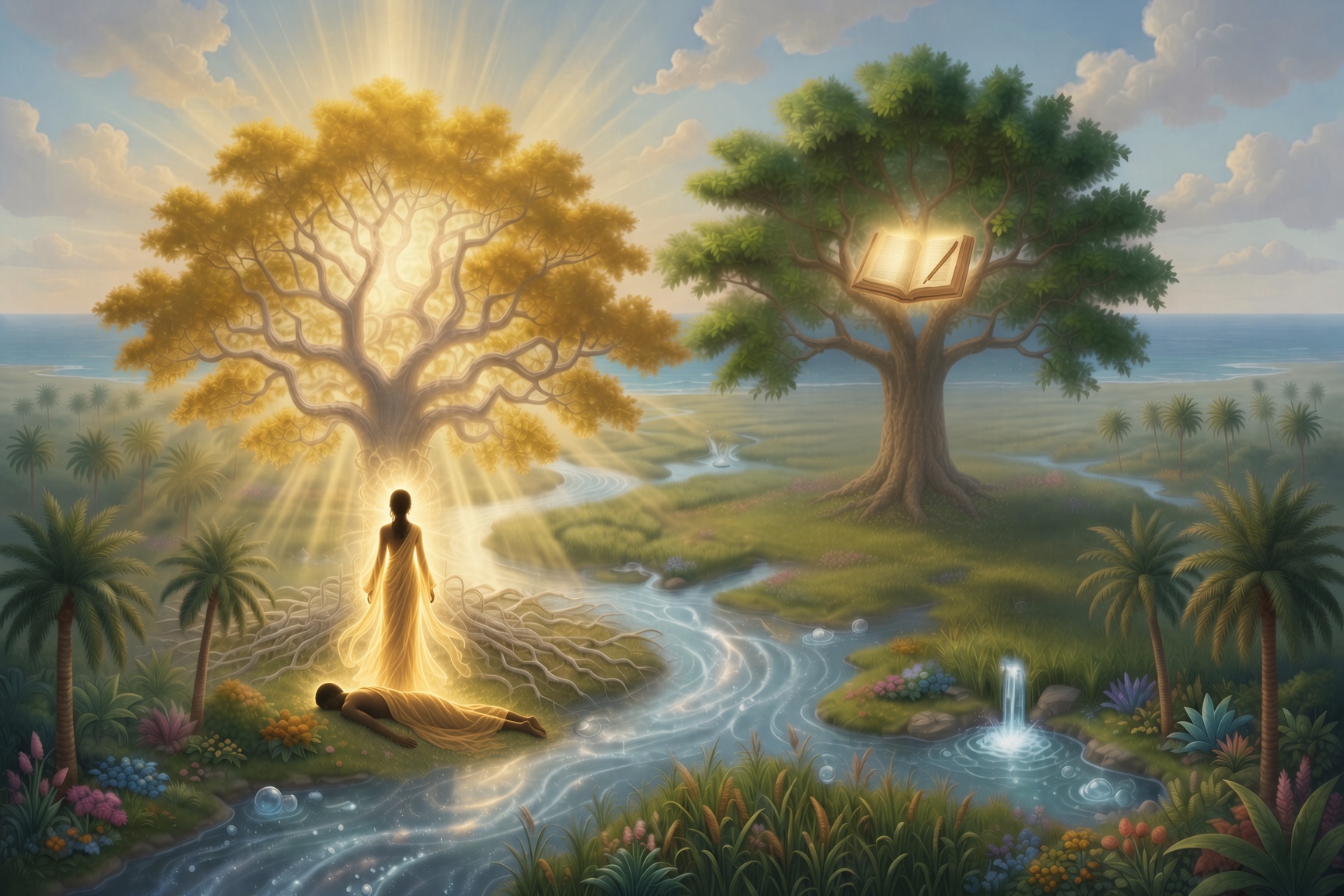
Although humans were created mortal, biological death does not have the last word. The rib used to create the woman in Genesis 2:20–24 points to this deeper reality.
As John Walton explains in The Lost World of Adam and Eve, the Hebrew word for the “rib” (tsela) is often used architecturally to mean “side”, typically describing one side of a holy structure such as the temple, the tabernacle, or the ark (Walton 2015: 77-81). This word choice suggests that God intended the mortal and God’s Wisdom to become two sides of one holy union just as men and women become united as one in marriage.
Yet, with Sumerian, more of the rib’s significance can be revealed. The Sumerian word for rib is “ti”, and like Hebrew, it can mean “rib” or “side”:
However, “ti” is also the short form of “til₃” which can mean “to complete; to make complete, finish,” as well as “to live; to keep alive; to be old, long-lasting”:
ti = til₃ = to be complete, completed; (to be) old, long-lasting; to make complete, finish
ti = til₃ = (n.) life; (v.) to live (of a single person); to keep alive, sustain [tìla, tìl, ti, page 33]
Mark Cohen’s Annotated Sumerian Dictionary associates the Sumerian morpheme ti with “rib”, “life”, and “to live” as well, but he also observes that it can mean “to take” and “to become, to change into” [pages 1352-1354]:
ti = “to take”
ti = “to become, to change into”
Therefore, several significant things are happening as God creates the mortal’s wisdom-wife from the “rib”:
God is creating wisdom as wife to be the other side and helper of the human mortal.
She will complete and complement the mortal as the other side of this holy union between wisdom and mortality.
God is taking something from within the mortal and changing it to bring about eternal life.
The wisdom-wife given by God is intended to transform the mortal’s mortality into immortality — abundant “Life” with God in this life and the afterlife.
In other words, the story depicts God bringing forth Life from those who are doomed to die. God draws a “rib” from the side of the “sleeping” mortal (the “corpse”/ha-adam) and creates a woman — wisdom — who will be associated with “Life” (Genesis 2:18–24; 3:20).
When this is combined with the metaphor of the mortal and God’s wisdom becoming “one flesh”, the text suggests that every human being is made to experience both biological death and posthumous life.
Just as God’s breath gave biological life to the dust of mortality, God is able to draw forth eternal Life from within mortals, clothing what is mortal with immortality:
“Then the Lord God formed a mortal (“corpse”/ha-adam) from the dust of the ground and breathed into its nostrils the breath of life, and the “corpse” (ha-adam) became a living being.” (Genesis 2:7)
“I declare to you, brothers and sisters, that flesh and blood cannot inherit the kingdom of God, nor does the perishable inherit the imperishable. Listen, I tell you a mystery: We will not all sleep, but we will all be changed —in a flash, in the twinkling of an eye, at the last trumpet. For the trumpet will sound, the dead will be raised imperishable, and we will be changed. For the perishable must clothe itself with the imperishable, and the mortal with immortality. When the perishable has been clothed with the imperishable, and the mortal with immortality, then the saying that is written will come true: ‘Death has been swallowed up in victory.’” (1 Corinthians 15:50–54)
Previous: “Wisdom as Wife”