
Wisdom as Wife
After the mortal is commissioned with their priestly work in the Garden of Eden, God gives the mortal a suitable helper who will enable them to fulfill their responsibilities:
“The Lord God said, ‘It is not good for the mortal to be alone. I will make a helper (ezer) suitable for it.’
“Now the Lord God had formed out of the ground all the wild animals and all the birds in the sky. He brought them to the mortal to see what it would name them; and whatever the mortal called each living creature, that was its name. So the mortal gave names to all the livestock, the birds in the sky and all the wild animals.
“But for the mortal no suitable helper (ezer) was found. So the Lord God caused the mortal to fall into a deep sleep; and while it was sleeping, he took one of the mortal’s ribs and then closed up the place with flesh. Then the Lord God made a wife (ishah) from the rib (tsela) he had taken out of the mortal, and he brought her to the mortal.” (Genesis 2:18-22)
Now it is reasonable to ask, “Who or what is the ‘wife’ that God presents to male and female mortals to be a ‘helper’ in sacred space?”
It should be observed that the Hebrew word used for “help/helper” (ezer) is most often used to describe the "help" that God offers to those he loves (Deut 33:7; 33:26; Ps 20:2; 70:5; 115:9–11; 121:1–2; 124:8; 146:5").
For example, Deuteronomy 33:29 refers to God as Israel’s ezer:
Blessed are you, Israel! Who is like you, a people saved by the Lord? He is your shield and helper (ezer) and your glorious sword. Your enemies will cower before you, and you will tread on their heights.”
Moses referred to God as his ezer (Exodus 18:4b):
“My father’s God was my helper (ezer); he saved me from the sword of Pharaoh.”
Similarly, Psalm 33:20 declares that God is the source of help and protection:
“We wait in hope for the Lord; he is our help (ezer) and our shield.”
The word ezer is associated with the divine assistance that God provides. It is utilized in the context of a warrior ally who helps fight alongside another and there is no scriptural example of subservience or sexual connotations implied in its usage.
Furthermore, the role of this woman in the garden is to help keep sacred space, not to provide a reproductive partner. God has already blessed men and women with sexual procreation in Genesis 1:26–28, so the issue of families and offspring has already been addressed. And unlike the fertility cults of pagans, sex was never permitted in the sacred space of God. So, why would God search among the animals if he was looking for a reproductive partner for the human mortal?
It appears that God brought the animals to the mortal for two likely reasons. First, so the mortal might name the animals, adding to the knowledge and wisdom already given by God. Second and more importantly, to show that none of them was the mortal’s ontological equal able to serve and protect in sacred space. Only “the woman” God has made is suitable to be the mortal’s equal and helper (ezer) in the holy place of God.
So, “Who or what is the wife that God presents to male and female mortals to be a helper in sacred space?”
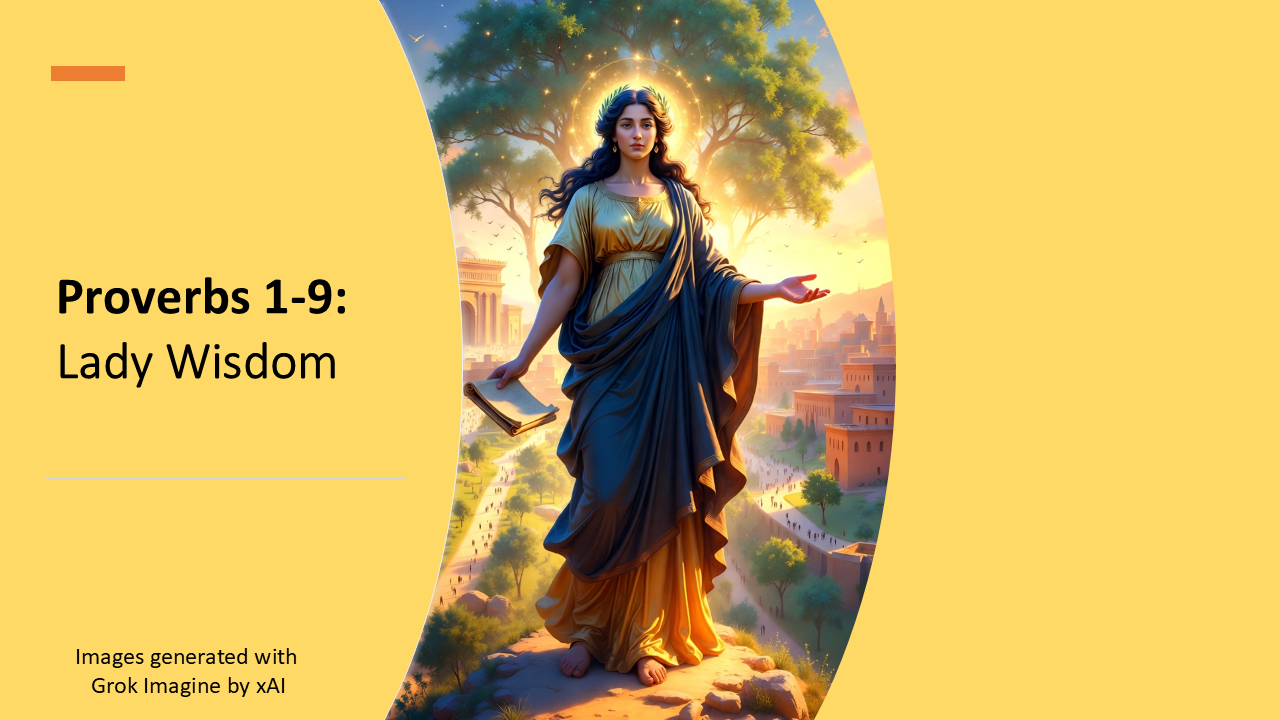
She is “wisdom” who can provide heavenly help from God. This identification of the helper as wisdom is not unique to Genesis. Wisdom personified as a wife was already a familiar motif in the ancient Mesopotamian world, and the same imagery appears throughout the Book of Proverbs.
In Proverbs 1:20-33, wisdom cries out in the streets and public squares, rebuking the simple and warning of the consequences of rejecting her.
God’s wisdom is personified as a beautiful woman who calls from the heights and city gates in Proverbs 8:1-36 where she describes her value, her role in creation, and the life she offers.
In Proverbs 9:1-6, Lady Wisdom welcomes all who are simple to come into her house and learn her ways that lead to life.
The ways of Wisdom bring peace and blessedness, and she is “a tree of life to those who take hold of her,” (Proverbs 3:13-18).
In Proverbs 4:5-9, mortals are urged to embrace God’s wisdom and cherish her like a wife:
“Get wisdom, get understanding;
do not forget my words or turn away from them.
Do not forsake wisdom, and she will protect you;
love her, and she will watch over you.
The beginning of wisdom is this: Get wisdom.
Though it cost all you have, get understanding.
Cherish her, and she will exalt you;
embrace her, and she will honor you.
She will give you a garland to grace your head
and present you with a glorious crown.”
God gives mortals wisdom as wife and helpmate. God gives mortals wisdom as wife in Eden because she is the only suitable helper (ezer) to protect sacred space.
So, just as “the mortal” or “the man” is being used as a corporate archetypal symbol for all human beings — male and female — “the wife” is being used as an archetypal symbol for wisdom given to help human beings.
This helps to explain Genesis 2:23-24:
“The mortal (ha-adam) said,
‘This is now bone of my bones and flesh of my flesh;
she shall be called ishah (wife/woman),
for she was taken out of ish (husband/man).’
“That is why a man (ish) leaves his father and mother and is united to his wife (ishah) and they become one flesh.”
In this context of marriage, the similar sounding words — ish and ishah — would stay in the listener’s memory and refer to husband and wife, respectively. It should be pointed out that to “become one flesh” was a metaphor for uniting, and does not make sense when taken literally. When men and women marry one another, they still remain two separate bodies of flesh, but the phrase “become one flesh” depicts the unified relationship of the two into one. Likewise in the context of this story, the narrative of the text appears to be using the metaphor of marriage to depict the mortal’s embrace of wisdom as wife.
It is helpful to note that this passage need not refer only to the moment when a man left his parents in order to marry. A young man could leave his father’s household once he reached adulthood — figuratively embracing wisdom as wife — whether or not he was married. We see an example of this when Jacob left his parents, Isaac and Rebekah, for the household of his uncle Laban in Paddan Aram, where he waited seven years before marrying (Genesis 28:1-5; 29:1-30).
In the context of the sacred space of Eden, therefore, Genesis 2:23-24 more likely refers to the holy union of the mortal with the helper God provides — wisdom — than to the sexual union of a biological man and woman. This reading is further supported by the fact that sexual relations were forbidden in sacred space (Exodus 19:9-15; Leviticus 15:16-18; 15:31; 22:3-9).
The Bible often uses marital images of a bride and groom to symbolize God uniting with his people. The martial metaphor is found in other Scripture passages, like Isaiah 54:5-6 and Hosea 2:19-20. The image of mortals embracing the wisdom of God as their bride is introduced here in Genesis 2:23-24. This marriage metaphor returns in the last chapters of the Bible in Revelation 19:7-9 where the archetypal roles are reversed:
“‘Let us be glad and rejoice,
and let us give honor to [the Lord our God].
“For the time has come for the wedding feast of the Lamb,
and his bride has prepared herself.
“She has been given the finest of pure white linen to wear.’
For the fine linen represents the good deeds of God’s holy people.
“And the angel said to me, ‘Write this: Blessed are those who are invited to the wedding feast of the Lamb.’ And he added, ‘These are true words that come from God.’”
Here in Revelation, the holy people of God are now depicted as the bride — the woman — because they have embraced the wisdom of God, which is personified as a woman. In this metaphor, mortals who were faithful to the wisdom of God are eternally united with their groom — the Lamb of God, Jesus Christ — in the joy of heavenly consummation at the end of the age.
Previous: “Guard and Keep: the Water of Life”